GiTech · COP 报告指南COP presenting guide
COP31 · 土耳其安塔利亚 · 2026 年 11 月 9–20 日

在 COP 上做报告:往届经验与实用指南

往届报告人的演示稿怎么做、录像去哪里看、一场 60–90 分钟的展馆边会里什么管用——为准备在 COP31 介绍清洁能源与生态保护实践的单位整理。

整理于 2026 年 10 月 16 日 · 来源全部附链接 · 图片为公开录像与演示稿的截图,仅用于评述,版权归原作者所有

25
段往届录像
67
张关键画面,带时间点
10+
份演示稿逐页分析
8
道难题,附回答要点

01要点速览

按 60–90 分钟中国角边会里 8–12 分钟的发言来准备:开场给出一个经过核实的减排数字,生态措施拿出监测结果,最好带一项可以发布的成果。

  1. 时间短。COP28 中国角每场 75 分钟,含多位领导致辞、2–3 个主旨发言和一场圆桌。10 分钟发言准备 8–10 页正文。
  2. 有些题材在这个舞台上还是空白。COP26 至 COP30,中国角没有出现以水风光一体化基地或鱼类与河流保护为主题的专场。
  3. 想被报道,就带「成果」和「外国声音」。报道多的能源企业专场,都发布了报告、倡议或合作备忘录,并请到 IRENA、IEA、WBCSD 或东道国嘉宾同台。
  4. 一页一个结论。标题写成完整句子,配一张图或一两张照片,正文字号不小于 24 磅,英文为主,图表标签全部译成英文。
  5. 经得起追问。每个数字注明方法、基准和核查方;「避免排放」单独标注;加一句「我们还在改进什么」。
  6. 预演难题:水库甲烷、过鱼效果、谁来核查、集团煤电、对河流的累积影响、当地社区。
  7. 语言:英语流利才用英语;否则用中文加同传,提前 3–5 天把演示稿、讲稿和术语表交给译员。
  8. 技术:16:9、1920×1080 的 PPTX,只用微软字体,视频另附 MP4,带两个 U 盘;上台前通常只有约 15 分钟调试。
  9. 大部分传播发生在会场之外。展馆回放往往只有几百次观看。自带机位,会后 48 小时内发布 2–3 分钟英文短片和演示稿 PDF。
  10. 尽早向主办方确认日期与时长、语言与同传、设备、直播平台。截至 2026 年 10 月 16 日,COP31 中国角日程尚未公布;COP28 的日程是开幕前一天才发出的。

02在 COP 上发言是怎么回事

中国角边会属于国家展馆活动,不是联合国官方边会:形式由中方主办方定,联合国的网络直播和会议室规则不适用。一场 60–90 分钟的会由很多人分享,企业发言人通常只有 8–12 分钟。

三类会场

表格可左右滑动 →

会场谁来办时长录像
联合国官方边会(蓝区)联合国秘书处;获准的观察员组织和缔约方通过 SEORS 系统申请固定 90 分钟(COP26 为 75 分钟);主席台 6–8 人逐年缩减:COP26–28 YouTube 直播,COP29 只有回放,COP30 不录像
国家或机构展馆(蓝区)各展馆自行运营;东道国以商业方式出租场地展馆自定:中国角 75 分钟(COP28),加拿大馆 45 分钟(COP31),太平洋馆 50 分钟(COP29)展馆自定
绿区东道国主办,对公众开放不固定不固定

两类蓝区会场都需要联合国注册证件。来源:联合国边会组织者手册 COP26、COP28、COP29、COP30;加拿大馆 FAQ;COP31 蓝区说明。

中国角

中国角由生态环境部主办,日程由国家应对气候变化战略研究和国际合作中心(NCSC)发布。COP28 的日程在开幕前一天(2023 年 11 月 29 日)才发出(上海市生态环境局转发的 NCSC 通知)。场次越来越少、越来越精:

届次中国角活动
COP30 贝伦,202519 场主题边会、14 场特色活动、4 场展览(生态环境部)
COP29 巴库,202450 余场边会、10 场展览(生态环境部)
COP28 迪拜,2023100 余场边会,9 个主题日,两个会场并行,含「可再生能源日」和「企业日」

COP28 每场 75 分钟,开始时间为 09:00、10:45、13:00、14:45 和 16:30,场间留 30 分钟(新浪 COP28 日程)。典型流程是:几位领导简短致辞,2–3 个主旨或案例发言,4–7 人的圆桌,常附带一项报告发布。COP28 有一场在 75 分钟里排了 3 个主旨发言和 7 位讨论嘉宾(中新网)。

与水光互补基地最接近的先例,是国家电投黄河上游水电公司承办的「清洁能源促进绿色转型」边会(2023 年 12 月 9 日):7 位嘉宾致辞,6 家机构参与圆桌交流,全球直播约 2.9 万人在线观看(中国日报)。COP30 的能源转型边会请到 IRENA 总干事和丹麦气候大使与中方气候特使同台,发布了 4 份报告(新华网)。

没有任何公开资料说明中国角的工作语言、同传安排、设备配置和直播平台。这四项请直接向主办方确认。

联合国官方边会的会场与设备

表格可左右滑动 →

届次座位屏幕与话筒直播 / 录像同传
COP30100–2002 块 85 寸主屏、3 块 32 寸返送屏、6–8 支按键话筒仅注册者可看 Teams 直播;不录像9 间中 3 间有;组织方付费
COP2980–1774 块液晶屏;两人共用一支话筒;不能接自带电脑虚拟平台直播;回放事后上传 YouTube9 间中 3 间有
COP28123–1734 块液晶屏、6 支固定话筒、倒计时钟虚拟平台、联合国官网、YouTube每间 2 个同传间,200 副耳机
COP2777–300投影屏,8 人主席台配 4 支台式话筒YouTube 直播与回放部分会场有
COP2643–1742 块投影屏,每位发言人一支领夹话筒默认 YouTube 直播每间 4 个同传间

COP26 到 COP30 有五条规则从未变过,可以当作 COP31 任何会场的默认要求:

  • 演示稿 16:9、1920×1080,PowerPoint 格式。
  • 「只支持微软字体」:中文用微软雅黑或黑体,或者把字体嵌入文件。
  • 视频嵌入演示稿,同时另备一份 MP4(H.264),不用有版权的音乐。
  • 当天用 U 盘交文件,不能提前发送。
  • 开场前 15 分钟才能进场调试。

03往届报告人怎么做演示稿

在中国角发言的中国能源企业,通常先讲规模,再讲一个旗舰案例,最后提出合作意向。被报道得多的场次,都有一项成果发布和一位国际嘉宾。

中国能源企业在中国角

表格可左右滑动 →

届次边会与主办做法
COP30,2025-11-18碳中和与能源智联;清华大学与华能(首次承办)发布报告;华能的海上漂浮式光伏平台是唯一入选国际案例集的中国案例
COP30,2025-11-13构建新型电力系统;国家电网(首次承办)IRENA 主旨发言,巴西电力监管机构负责人同台,WBCSD 主持圆桌;51 家机构联署倡议;会前有琵琶和茶艺表演
COP29,2024-11-14电力行业绿色低碳发展;中电联与大唐IEA 在会上发布电力系统灵活性研究;当天下午大唐与阿塞拜疆能源部签署合作备忘录
COP28,2023-12-09清洁能源促进绿色转型;国家电投、中电联、中国能建,黄河上游水电公司承办先讲规模(装机超 2.4 亿千瓦、清洁能源占比超 70%、业务遍及 47 个国家和地区),再讲沙特光伏案例,最后提出合作意向;发布中电联白皮书;现场约 80 人,线上约 3 万人
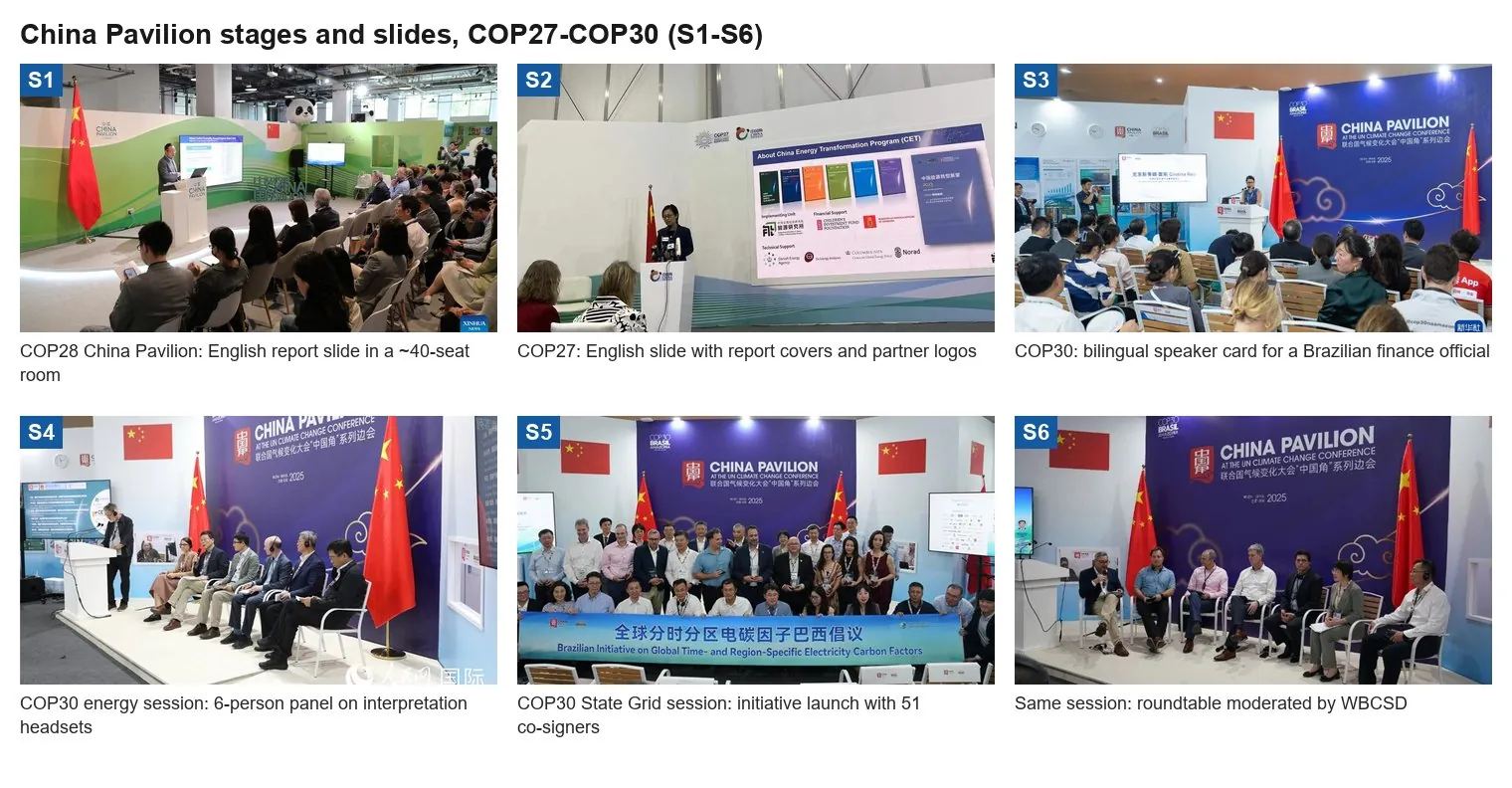
COP27 至 COP30 中国角的舞台与演示画面 S1 至 S6
COP27–COP30 中国角舞台与演示画面(S1–S6)。来源:新华网、中国能源转型项目、人民网、WBCSD。点击查看大图。

这些场次说明:

  • 流程固定。领导致辞 → 企业负责人发言 → 国际嘉宾主旨发言 → 圆桌 → 成果发布(报告、倡议或备忘录)→ 合影。企业发言人是在这个框架里发言,不负责开场。
  • 报道跟着「成果」和「外国声音」走。报道多的场次都有发布,并有 IRENA、IEA、WBCSD 或东道国嘉宾。在安塔利亚,对应的可以是土耳其的电力企业或监管机构,或谈水电的 IHA、IRENA。
  • 会场小,直播大。COP28 有一个会场只有约 40 个座位(S1);国家电投那一场现场约 80 人,线上约 3 万人。
  • COP28 有同传。中国角用了科大讯飞的同声传译和实时双语字幕(人民日报)。
  • 常见的弱点:英文标题下的图表标签仍是中文、屏幕上的英文不地道、只讲「重点方向」而不给数据。

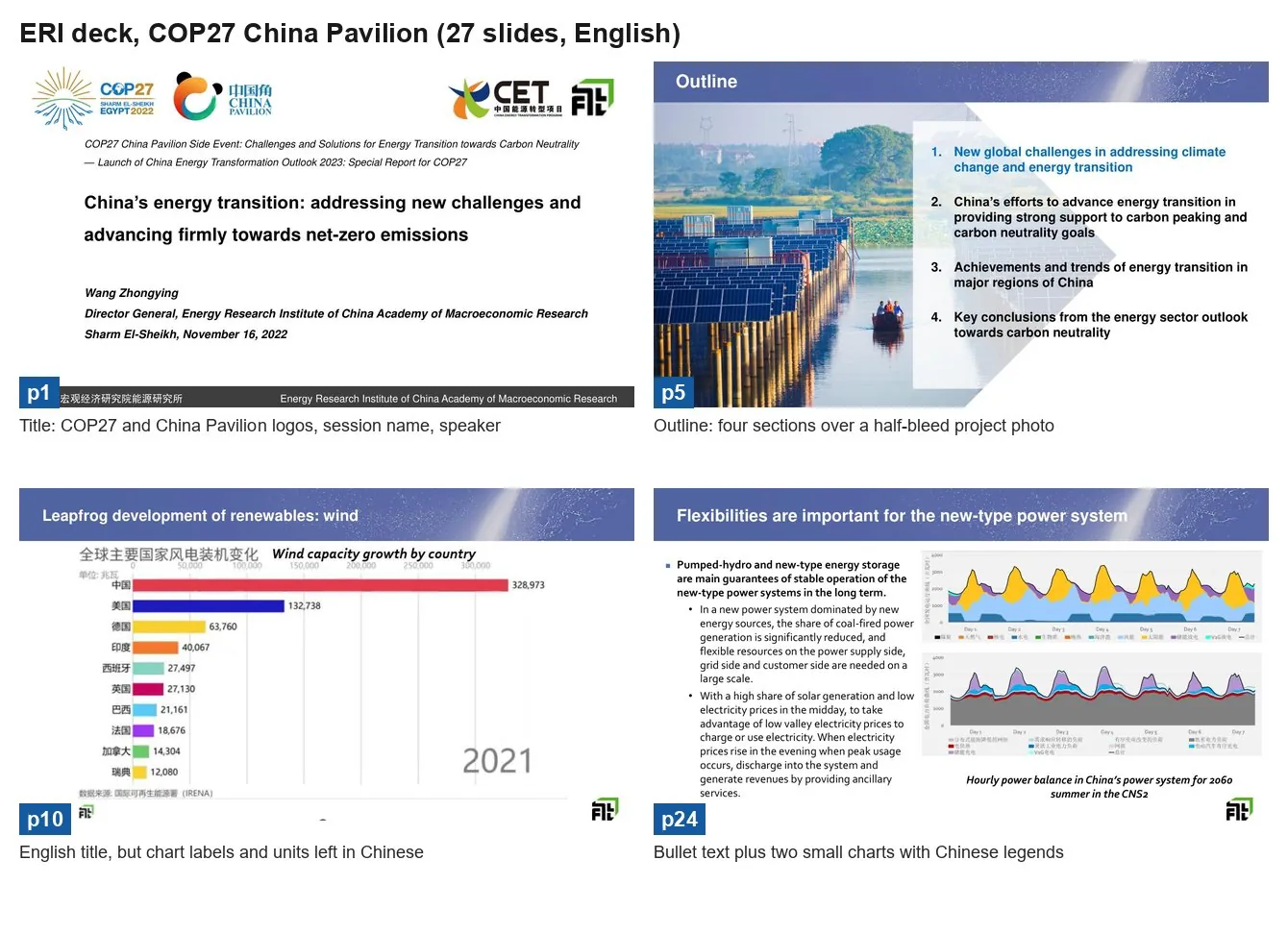
唯一公开的中国角演示稿:能源研究所,COP27

国家发改委能源研究所 27 页的英文演示稿,是网上唯一能找到的完整中国角演示稿(原文 PDF)。结构是:标题、机构介绍、引言、目录、全球挑战、中国进展(图表)、区域案例、2060 情景、总结。结构清楚,目录页用了一张很好的项目照片;但图表在英文标题下保留了中文的标签、单位和图例(第 10、24 页)。

能源研究所 COP27 演示稿第 1、5、10、24 页
能源研究所 COP27 演示稿第 1、5、10、24 页。来源:中国能源转型项目(CET)。点击查看大图。

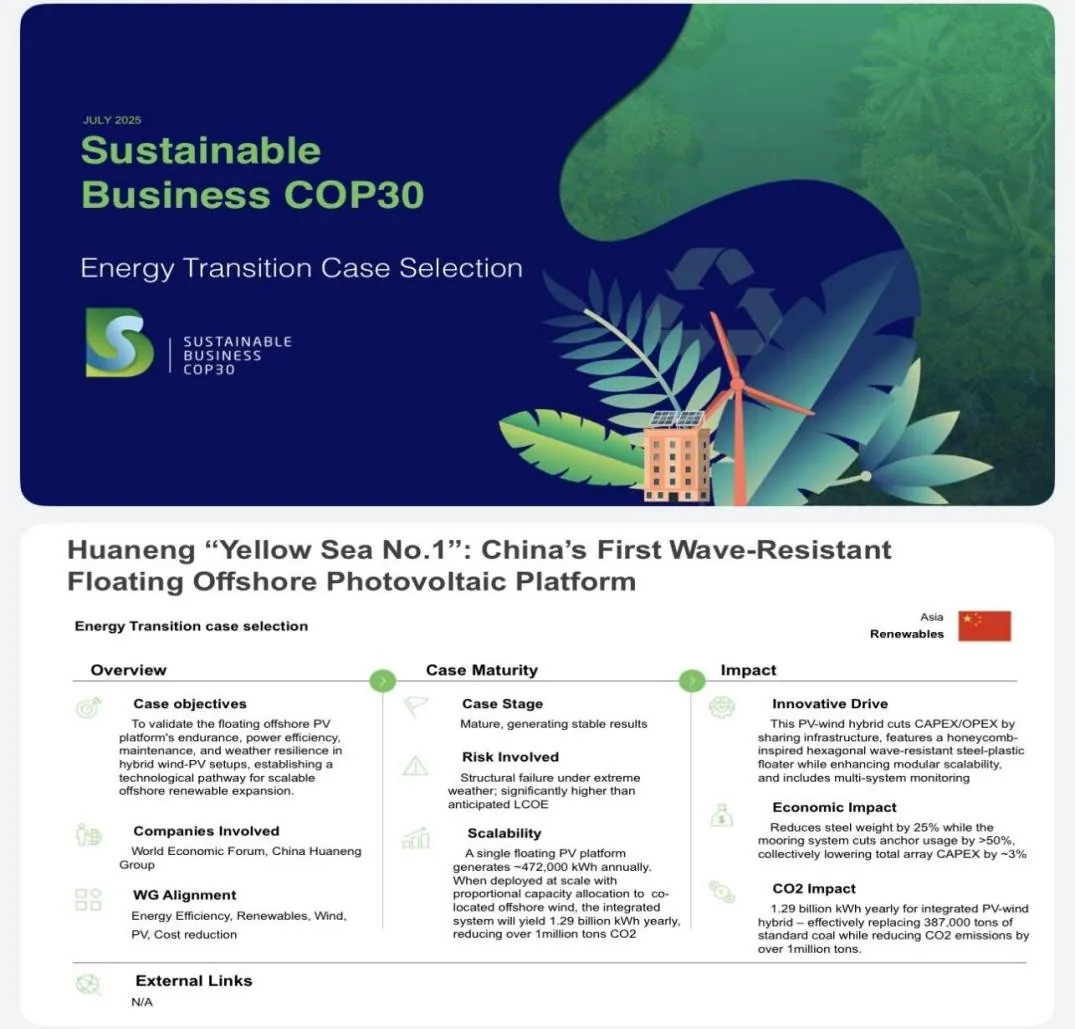
值得借用的模板:国际案例一页纸

华能「黄海一号」是 Sustainable Business COP30 能源转型案例集里唯一的中国案例(澎湃新闻)。这页纸用的是固定的国际模板:目标、参与方、所处阶段、风险、可推广性、创新点、经济效益、减碳效果。它把风险写在明处,这是国内演示稿常常省掉的。同样的结构适合水风光加生态的案例,也可以直接当会场发的一页纸。

Sustainable Business COP30 案例一页纸
Sustainable Business COP30 能源转型案例一页纸。来源:澎湃新闻。点击查看大图。

国际演示稿:好的有什么共同点

没有任何一届 COP 的水电演示稿可以公开下载:IHA 和伊泰普只公开会议说明、议程和录像。下面是最接近的真实样本:能源和河流方面的科学简报、一份顶尖的数据型演示稿,以及机构和企业的演示稿。表中链接均指向原发布方。

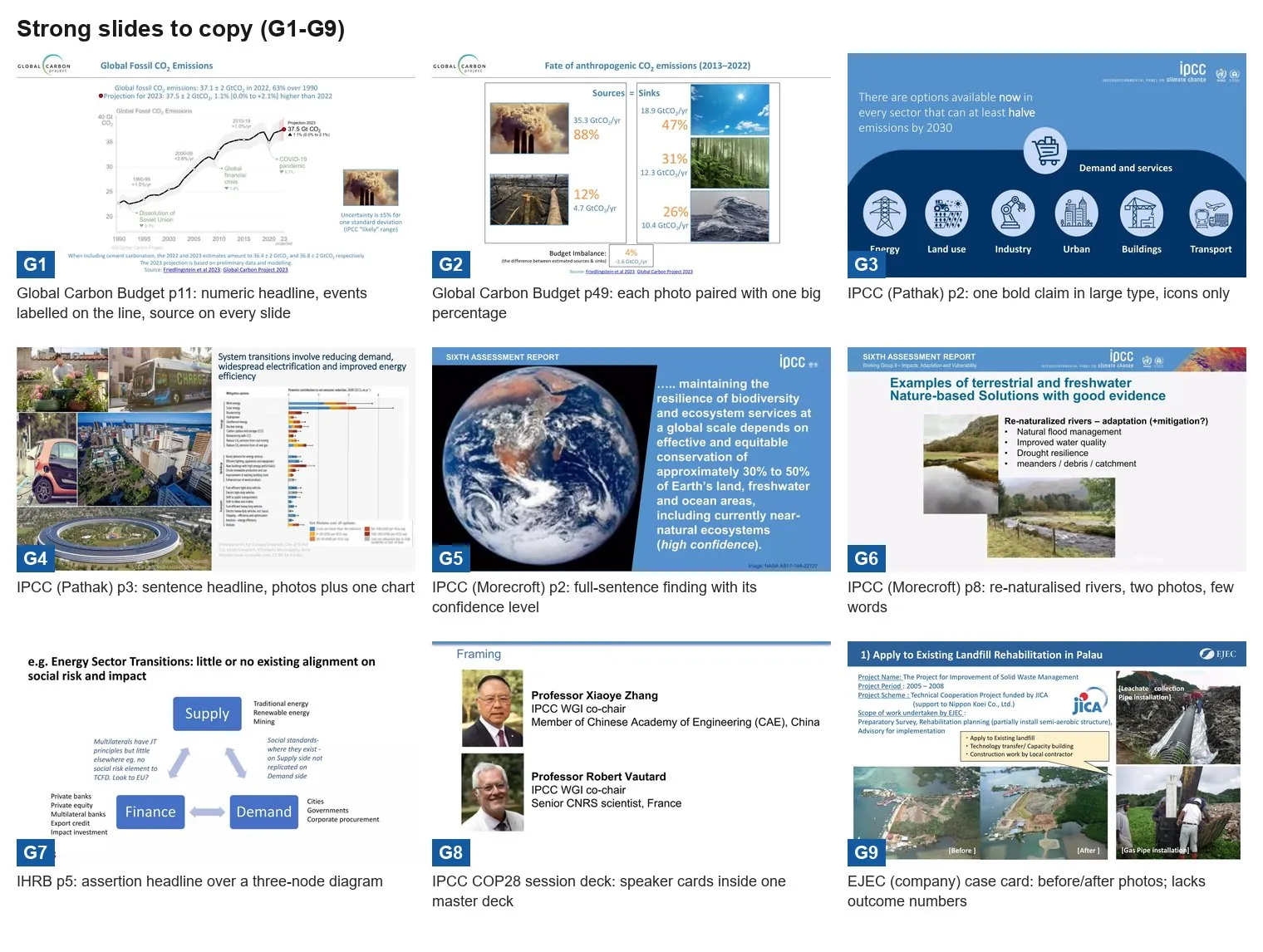
值得学习的幻灯片 G1 至 G9
值得学习的幻灯片(G1–G9)。来源:Global Carbon Project、IPCC、IHRB、Eight-Japan Engineering Consultants。点击查看大图。

表格可左右滑动 →

#演示稿场合页数学什么
G1, G2全球碳预算 2023COP28 发布,2023-12-0594主题标题下面放一两行硬数字;事件直接标在曲线上;每页都有来源
G3, G4IPCC 能源系统转型(Pathak)COP28 IPCC 展馆9开场一句大字论断:每个行业「现在」就有办法把排放「至少减半」
G5IPCC 淡水生态系统(Morecroft)COP27 IPCC 展馆6每个标题都是完整句子,并标明可信度;有一页坦白说明局限
G6IPCC 基于自然的解决方案(Morecroft)COP27 IPCC 展馆14「河流再自然化」只用两张照片和四行短句
G7IHRB 公正能源转型COP27 IPCC 展馆6句子式标题,品牌元素极少,以具体的下一步收尾
G8IPCC「全球变暖到哪一步了」COP28,一场 90 分钟30一份总控演示稿串起多位嘉宾,每段用一张嘉宾卡片引出
G9日本八千代工程咨询COP28 日本馆8最像企业案例发言:一个项目一张卡片,配前后对比照片;缺的是量化结果
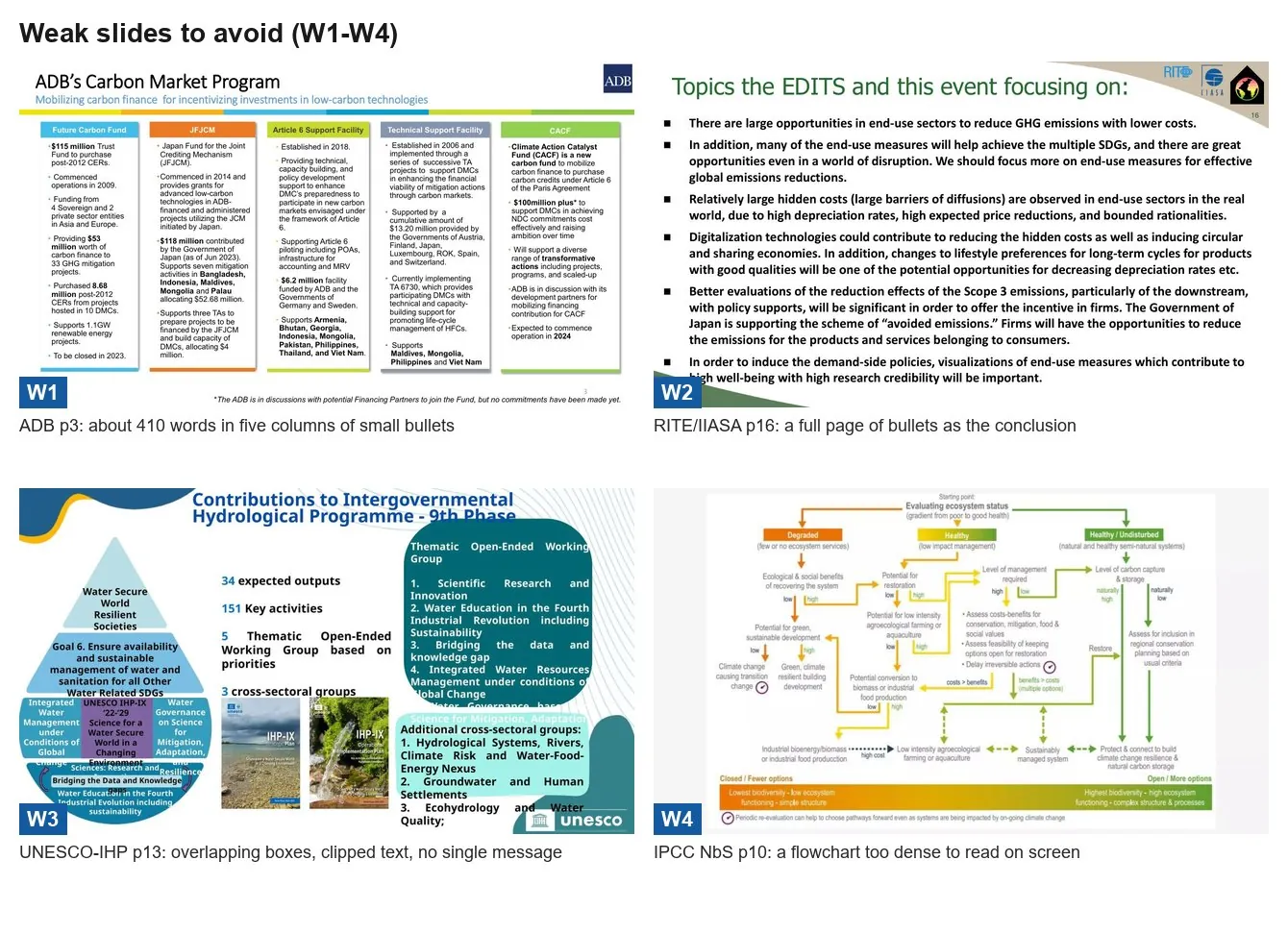
应当避免的幻灯片 W1 至 W4
应当避免的幻灯片(W1–W4)。来源:亚洲开发银行、RITE/IIASA、UNESCO、IPCC。点击图片查看大图。

差的演示稿错得很有规律:亚行第 3 页约 410 个英文单词;RITE/IIASA 每页中位数 132 个词;UNESCO 第 13 页方框重叠、文字被截断;IPCC 的一张流程图在会场里根本看不清。这四份都没有以「请求」或「邀请」收尾。

好坏之分,归结为五条:

  1. 一页一个信息,用一句话或一个硬数字说出来。
  2. 一页一张图,或一两张照片;图上直接标注,并注明来源。
  3. 正文不超过约 40 个英文单词。
  4. 标志只放在母版上一次,不要每页一排标志。
  5. 每个项目卡片都有量化结果,结尾给出合作邀请或下一步。

会后不公开的演示稿,等于没有留下来。IPCC 把每位嘉宾的演示稿和录像都放在官网上;联合国也要求官方边会组织者把演示稿上传到 SEORS(COP28 手册)。最终 PDF 也应放到本单位的英文网站上。

04录像与关键画面

中国角有一些边会的完整回放,但没有找到任何一场能源企业专场的回放。最接近的同类是中国石油 COP30 央企专场的 2 分半英文短片(A5)。以下链接均于 2026 年 10 月 16 日逐一打开核对。

在国内观看:B 站版本

25 段录像中有 6 段能在 B 站找到,图瓦卢外长的演讲有新闻片段。其余 18 段在 B 站没有;本节末尾的「关键画面」可以替代观看。

表格可左右滑动 →

#B 站链接时长字幕说明
A4BV1np4y1d7v14:01中文,压制完整
A6BV1Em4y1F7hr6:08中英,压制完整
A7BV1reUHBJEZy20:07 / 23:55中文节目删节转载
B8BV1jsUAYPErX3:18:14机翻中文完整;在生物多样性 COP16 的中国角举行,可见幻灯片
C1BV1cg411P7WY8:06 / 8:20仅英文演讲完整
C2BV1zL41177iF7:26中英,压制完整;字幕最好的一版
C4BV1UU4y1g7zX1:11中文新闻片段

B 站上没有任何能源企业中国角专场的回放,也没有水电主题的 COP 边会录像。

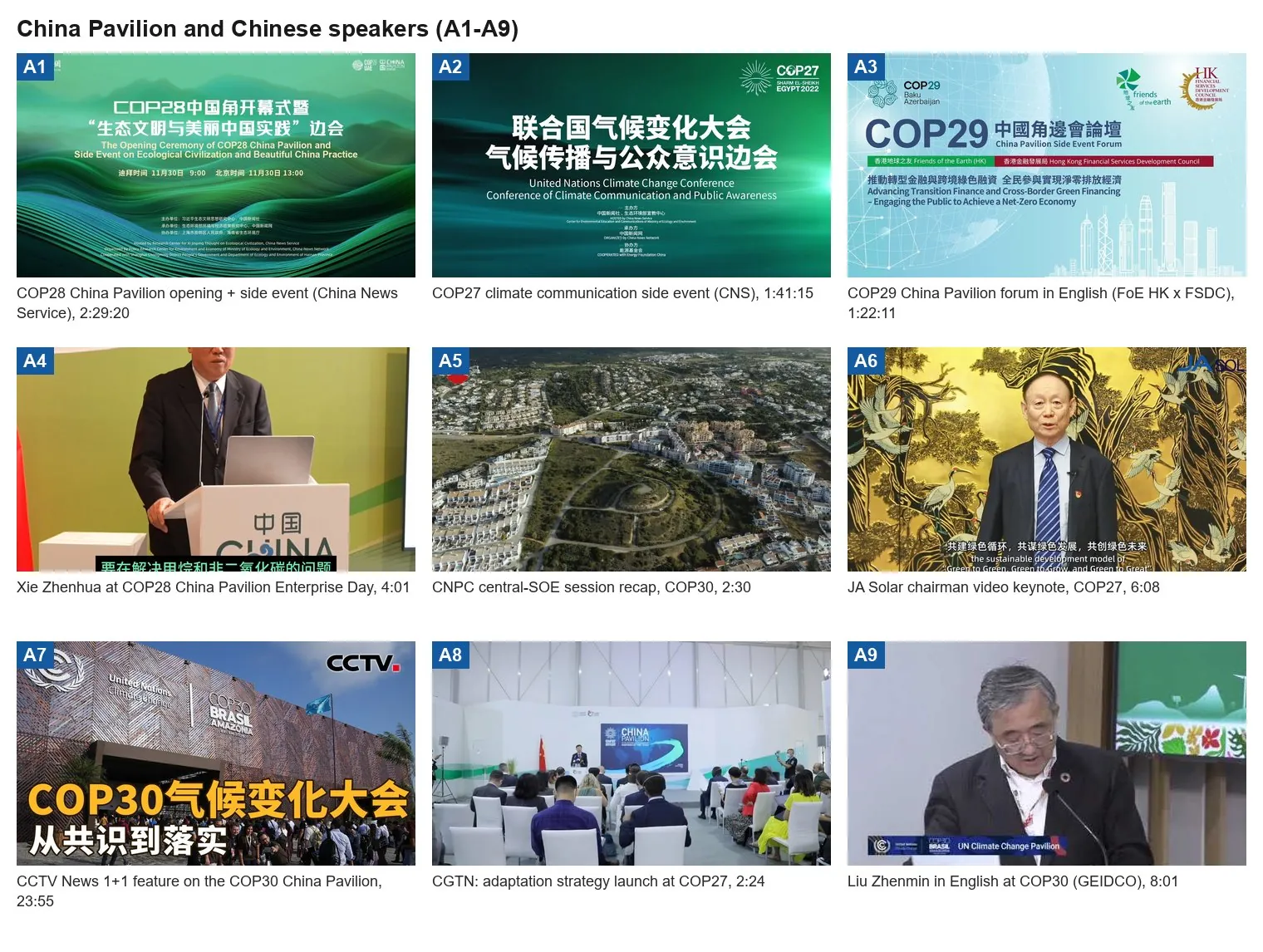
中国角与中国发言人

录像 A1 至 A9 缩略图
录像 A1–A9 缩略图。点击查看大图。

表格可左右滑动 →

#录像届次时长语言看什么
A1COP28 中国角开幕式暨边会(中新社)COP28,2023-11-302:29:20中文标准形式:讲台发言,一个固定机位。注意礼节性内容占了多少时间、谁会抬头看观众
A2「气候传播与公众意识」边会(中新社)COP27,2022-111:41:15中文站立讲解配大屏幻灯片,然后 4 人圆桌;主题正是中国主体如何讲气候行动
A3地球之友 × FSDC 中国角论坛COP29,2024-111:22:11英文极少数完整的英文中国角录像;看中方主持如何主持英文圆桌
A4解振华在 COP28 中国角企业日讲话(B 站)COP28,2023-124:01中文企业发言要接住的官方框架:可再生能源超过煤电、光伏与新能源车产业、拉低全球成本
A5中国石油央企专场回顾COP30,2025-11-192:30英文最接近的同类;企业当周就能发布的英文短片
A6晶澳董事长视频主旨演讲(B 站)COP27,2022-116:08中文,双语字幕高管无法到场时的备选;用三段式口号做记忆点
A7央视《新闻1+1》走进 COP30 中国角COP30,2025-11-1923:55中文国内电视会从中国角取什么;准备一句 10–15 秒的中文金句
A8CGTN:中国发布 2035 适应战略COP27,2022-11-102:24英文文件发布给了媒体新闻由头
A9刘振民英文发言(GEIDCO)COP30,2025-118:01英文高层官员低头念稿;与 C1–C3 对比眼神交流

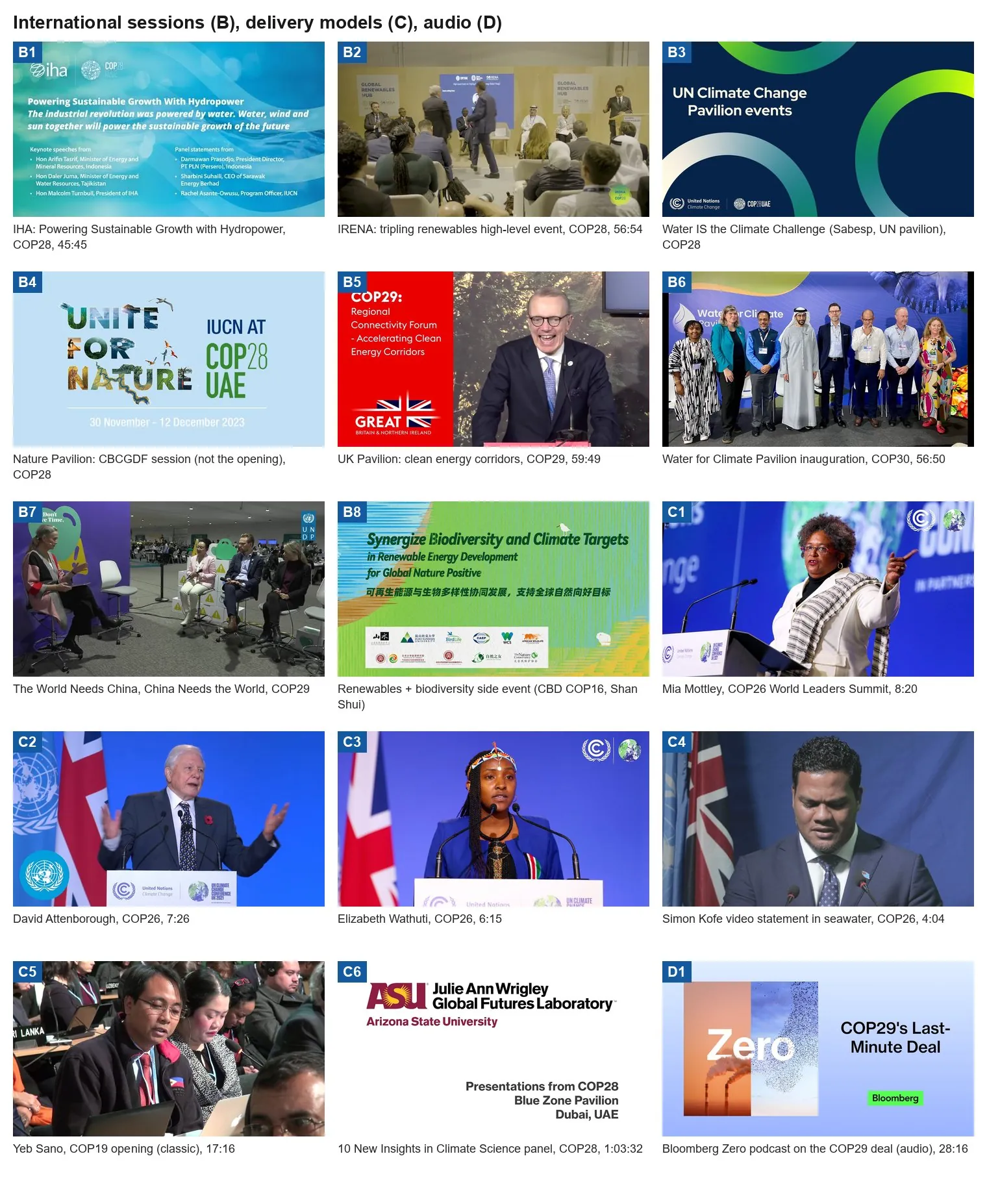
国际会场:水电、可再生能源、水与自然

录像 B1 至 D1 缩略图
录像 B1–D1 缩略图。点击查看大图。

表格可左右滑动 →

#录像届次时长看什么
B1IHA:以水电驱动可持续增长,印尼馆COP28,2023-12-0345:45唯一找到的水电专场。部长、电力企业负责人和 IUCN 同台。标题卡写着:「水、风、光一起,将驱动未来的可持续增长。」
B2IRENA:可再生能源三倍增长高级别活动COP28,2023-12-0256:54水风光基地可以嵌进去的「三倍增长」框架;只有一个远景机位,全靠话说清楚
B3「水就是气候挑战」(Sabesp,联合国气候变化馆)COP28,2023-121:28:16一家公用事业企业主办多方圆桌,把话筒让给伙伴
B4自然馆中一场中国基金会的边会(CBCGDF)COP2840:50并非标注的 IUCN 开幕式,而是关于电网护鸟的边会。题目对,呈现弱:幻灯片在浏览器窗口里、屏幕只有中文、现场约 8–10 人
B5英国馆:清洁能源走廊COP29,2024-11-1459:49精良的多机位混合制作,主题是跨区域电力互联
B6水与气候馆开馆(SIWI)COP30,2025-1156:50水领域的旗舰展馆;COP31 可能的合作会场
B7「世界需要中国,中国需要世界」COP29,2024-11-161:16:54国际媒体如何定位中国:最大排放国,也是最大清洁技术生产国。问答中会遇到这种框架
B8可再生能源与生物多样性协同边会(山水,B 站)生物多样性 COP16,20243:18:14可再生能源加生物多样性最贴题的内容;看术语和表述。不是气候大会

演讲范例

表格可左右滑动 →

#录像届次时长看什么
C1巴巴多斯总理莫特利COP268:20关键句前停顿;看着会场,不看稿子
C2大卫·爱登堡(B 站中英字幕)COP267:26一组不断上升的二氧化碳数字撑起整场演讲,配全屏画面,没有一页文字幻灯片
C3伊丽莎白·瓦图蒂COP266:15先讲个人故事,再提请求;一个本地细节承载全球信息
C4图瓦卢外长科非视频致辞COP264:04站在没膝的海水里录制;一个场景设计让边会视频家喻户晓
C5菲律宾代表萨诺COP19,201317:16坐着念稿也能打动全场,因为第一人称、具体
C6「气候科学十大新见解」圆桌(ASU)COP281:03:32反面教材:密集的文字幻灯片在镜头里看不清

只有音频:

这些录像告诉我们什么

  • 幻灯片很少进入回放。中国角直播通常是一个对准讲台的固定机位,侧面屏幕上的幻灯片在线上看不到。每个关键数字都要说出来。
  • 线上观看量很小。中国角回放大多只有 85–600 次观看,而莫特利的演讲有 68 万次,《卫报》剪辑的科非视频超过 100 万次。真正的传播靠现场、官方媒体报道和企业自己的短片。
  • 语言正在转向英文。COP27–28 中新社回放是中文;COP29 的论坛和 COP30 中国石油的回顾都是英文。
  • 著名的演讲都是 4–9 分钟,不用幻灯片,靠一个锚点撑住:一个数字、一个地方或一个画面。
  • COP31 的场次很可能出现在主席国的「COP31 Türkiye」YouTube 频道,该频道 2026 年 4 月已直播过一场 IEA 能源转型对话。

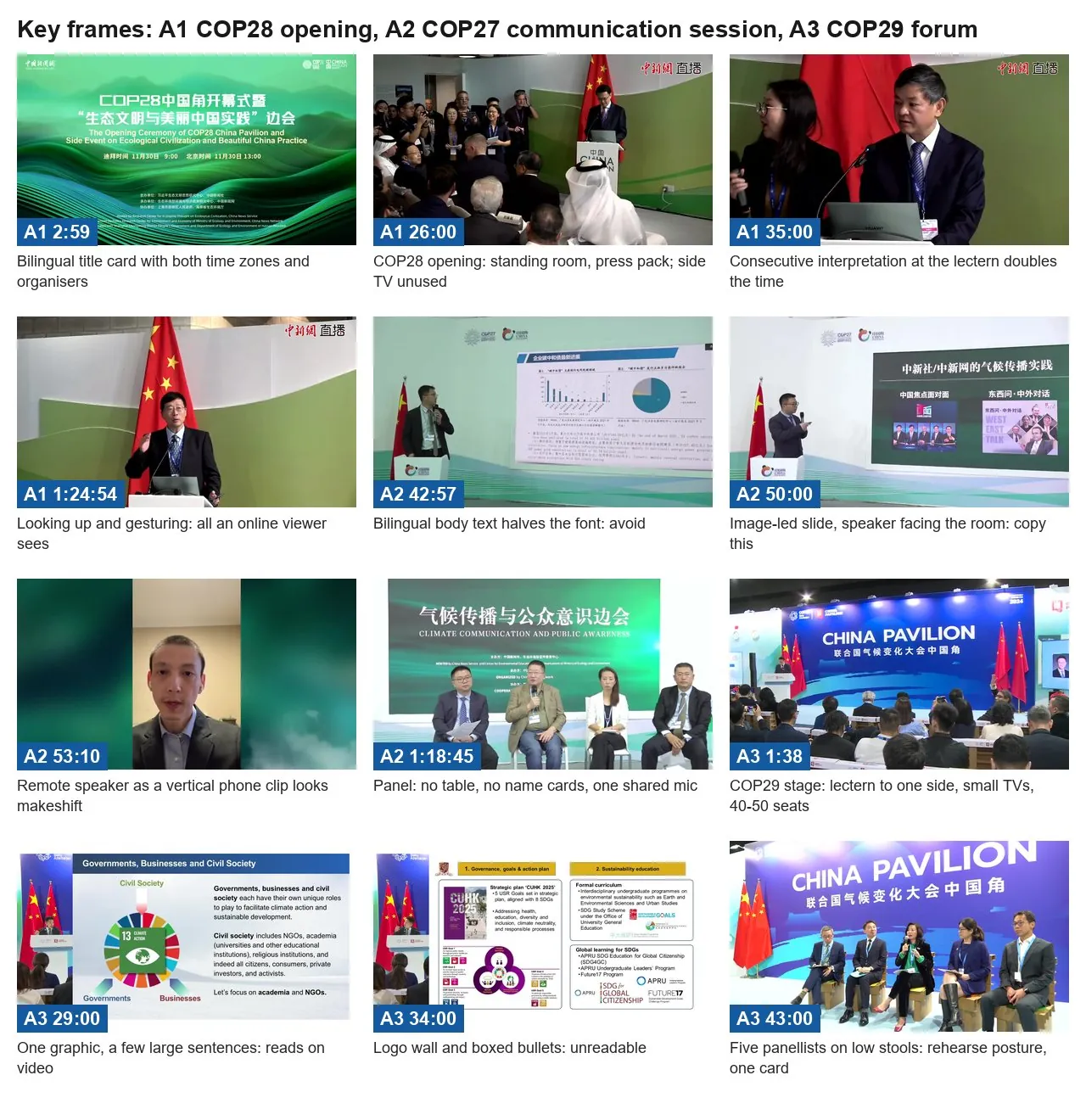
关键画面

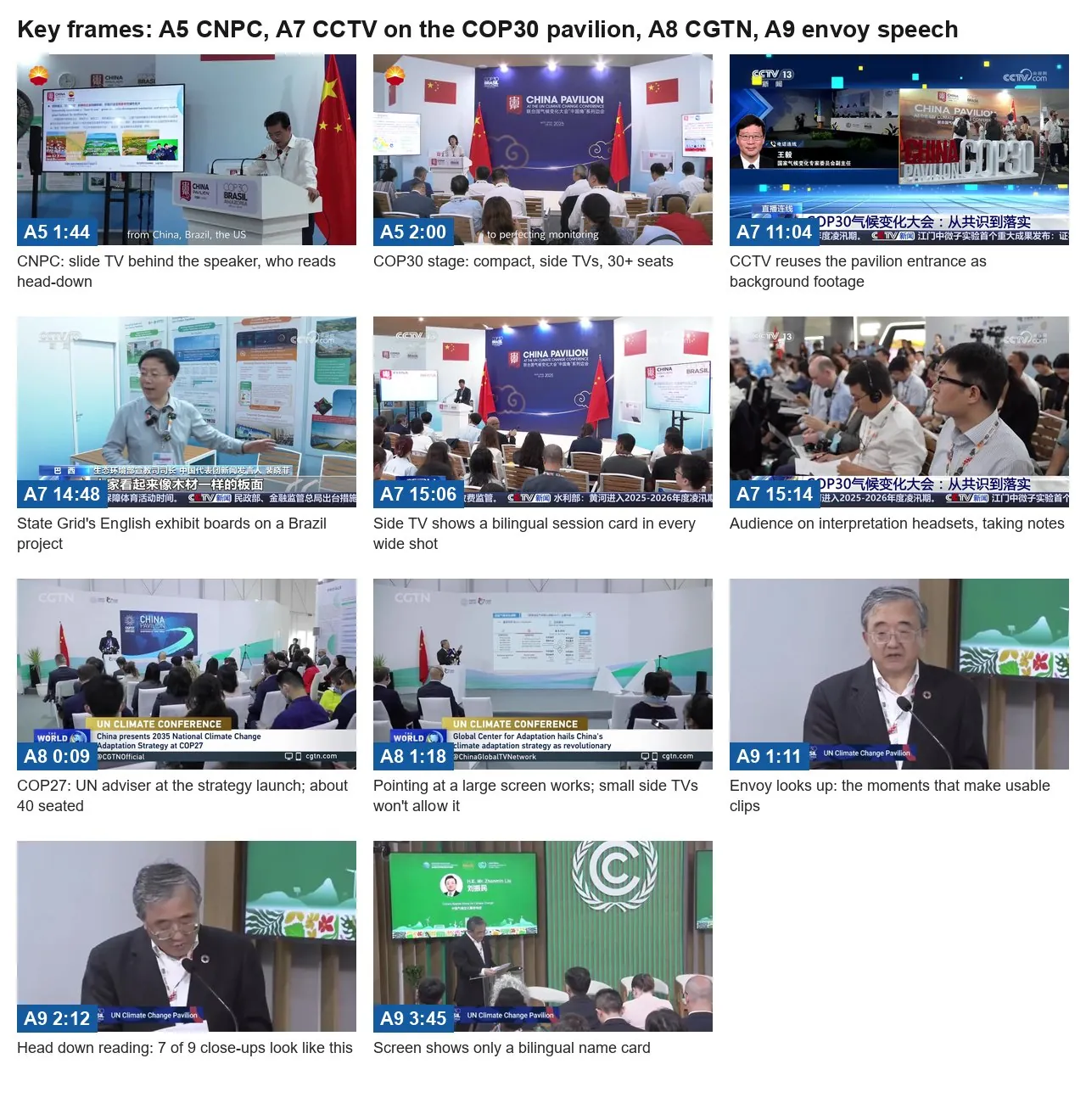
67 张截图抓住了值得学习的瞬间,不打开 YouTube 也能看懂。每个时间点都链接到录像对应位置。截图于 2026 年 10 月 16 日从视频流中截取。

中国角与中国发言人

关键画面 A1 至 A3
关键画面 A5 至 A9
点击图片查看大图。

表格可左右滑动 →

#时间点学什么
A12:59 · 26:00 · 35:00 · 1:24:54直播从不拍屏幕,线上观众只看得到眼神。交替传译让每个要点的时间翻倍
A242:57 · 50:00 · 53:10 · 1:18:45以图为主的幻灯片看得清,双语正文看不清。竖屏手机视频显得临时。圆桌没有桌子,只有一支话筒传着用
A31:38 · 29:00 · 34:00 · 43:00屏幕是侧面的小电视。一张图加几句话管用,一墙标志不行。圆桌坐矮凳
A51:44 · 2:00幻灯片电视在发言人身后,论证必须靠讲
A711:04 · 14:48 · 15:06 · 15:14国家电网的英文展板讲的是东道国项目。双语场次卡让每个远景都有标题。观众戴同传耳机
A80:09 · 1:18有联合国嘉宾同台的发布给了 CGTN 标题。指着幻灯片讲,只在大屏幕时可行
A91:11 · 2:12 · 3:45抬头的瞬间才剪得出可用的片段;低头念稿(9 个特写里有 7 个)剪不出来

国际会场

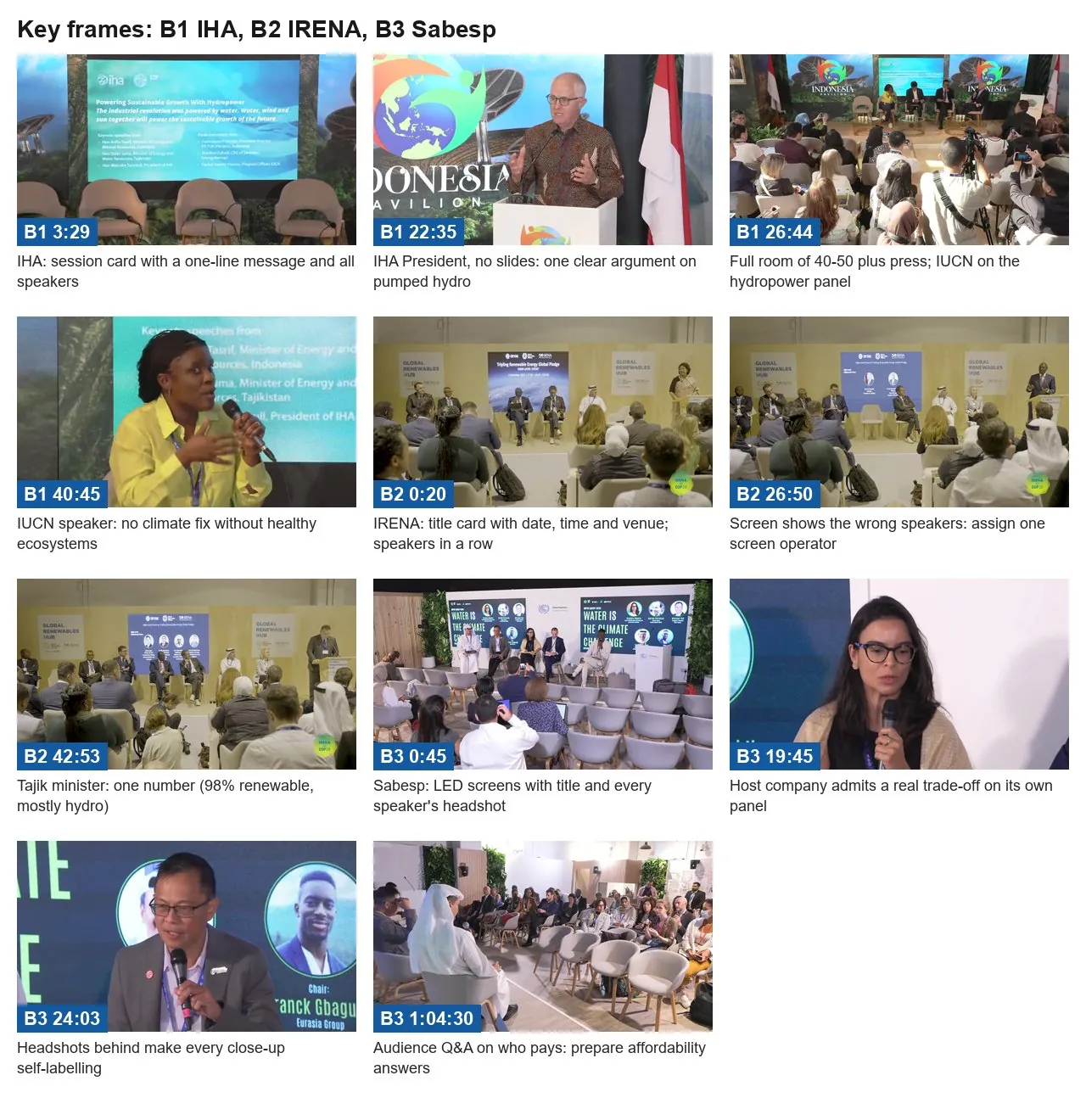
关键画面 B1 至 B3
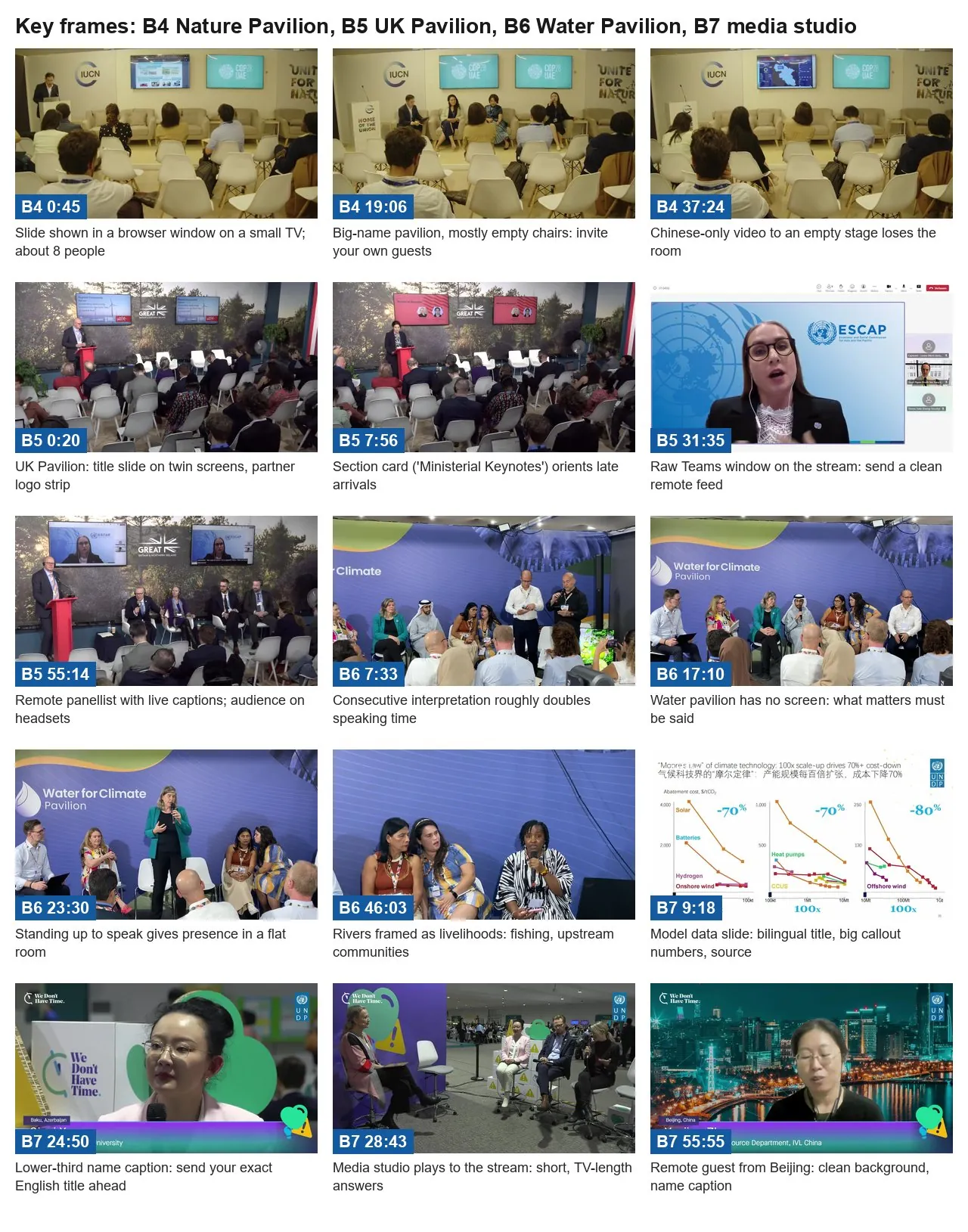
关键画面 B4 至 B7
点击图片查看大图。

表格可左右滑动 →

#时间点学什么
B13:29 · 22:35 · 26:44 · 40:45一张场次卡,写一句可引用的话并列出全部嘉宾。水电专场里请 IUCN 发声,提升可信度
B20:20 · 26:50 · 42:53标题卡写上日期、时间和地点。屏幕显示了错误的嘉宾:要有专人管屏幕。水电国家用一个数字讲清楚
B30:45 · 19:45 · 24:03 · 1:04:30屏幕上的嘉宾头像让每个特写自带名字。主办企业坦承取舍。准备好「谁来付钱」这类问题
B40:45 · 19:06 · 37:24要避免的:幻灯片在浏览器窗口里、只有中文的视频、现场约 8 人
B50:20 · 7:56 · 31:35 · 55:14章节卡让迟到的人知道进行到哪了。远程画面要干净,不要露出 Teams 界面。实时字幕有帮助
B67:33 · 17:10 · 23:30 · 46:03完全没有屏幕:重要的话必须说出来。河流被讲成生计
B79:18 · 24:50 · 28:43 · 55:55标准的双语数据幻灯片。提前提供准确的英文姓名和职务,用于字幕条

演讲范例

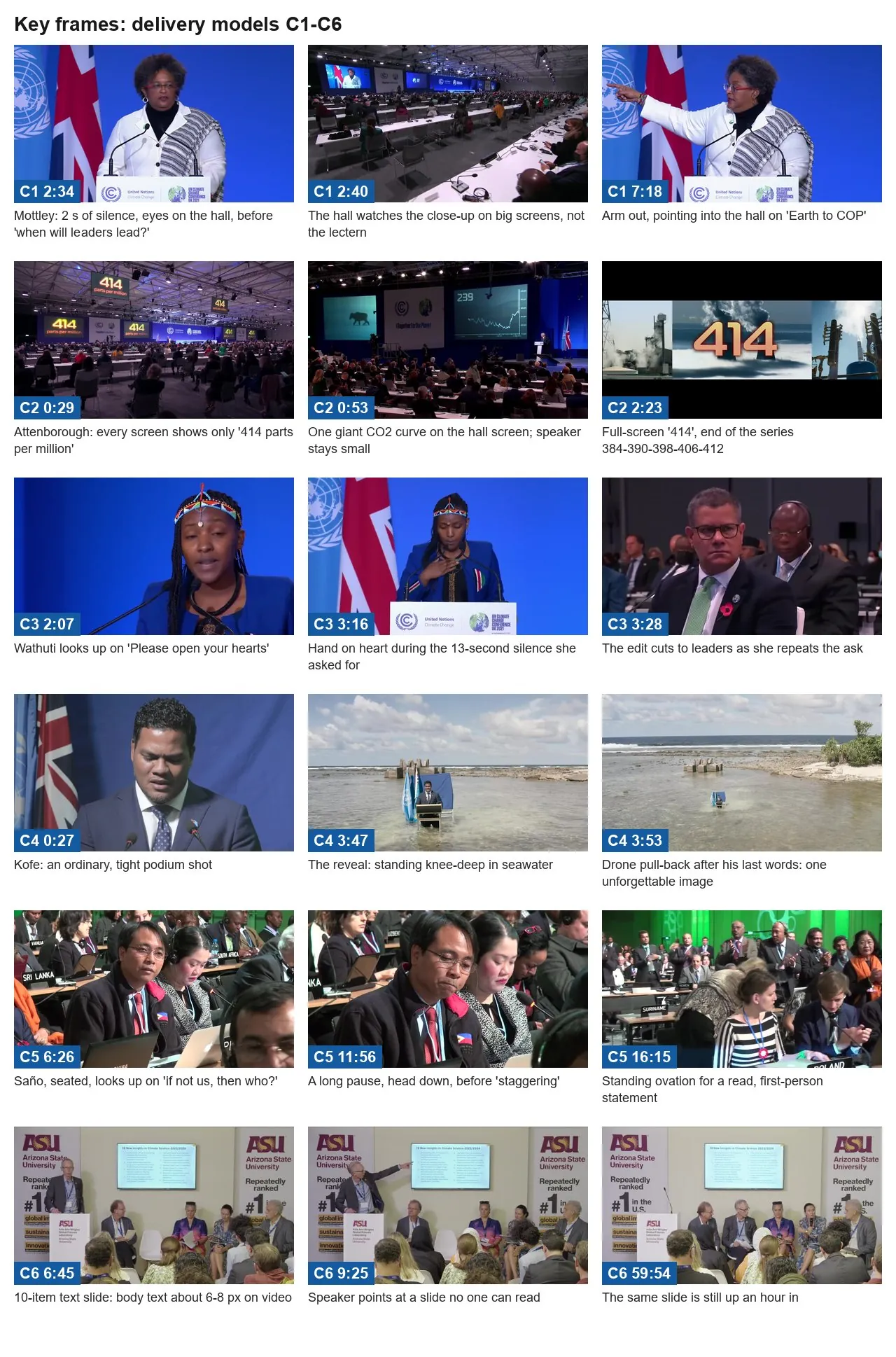
关键画面 C1 至 C6
点击图片查看大图。

表格可左右滑动 →

#时间点学什么
C12:34 · 2:40 · 7:18关键句前停两秒;全场看的是大屏上的特写
C20:29 · 0:53 · 2:23每块屏幕只有一个数字(414 ppm),一组上升的数字撑起整场
C32:07 · 3:16 · 3:28请全场静默 13 秒;镜头切到各国领导人
C40:27 · 3:47 · 3:53普通的讲台镜头,最后才揭开站在海水里
C56:26 · 11:56 · 16:15坐着念的声明赢得全场起立,因为第一人称、具体
C66:45 · 9:25 · 59:5410 条文字的幻灯片在镜头里一小时都看不清

05最佳做法与经验教训

在 COP 上管用的演示稿:一页一个结论,用可核查的数据支撑,并和全球目标挂钩,而不是用国内的口号。

为展馆会场设计幻灯片

  • 一页一个结论。每页标题写成完整句子,例如「基地每年避免约 X 百万吨二氧化碳排放」,再配一张图或一张照片作证据。宾夕法尼亚州立大学的研究显示,这种「论断—证据」式幻灯片让观众理解和记忆更好(研究列表)。
  • 字大字少。正文 24–28 磅以上,标题 36–40 磅,每页正文约 30 个英文单词。展馆灯光亮,用浅底深字(W3C 无障碍演示指南)。
  • 会场小而吵。COP31 加拿大馆约 25 个座位,每场 45 分钟、4–5 位嘉宾,两块屏幕用两种语言(加拿大馆 FAQ)。
  • 照片:每页一两张,真实、清晰(满屏图宽度不少于 1920 像素)。拍工程本身:鱼道、复绿边坡的前后对比、正在工作的技术人员。不要改动照片所记录的事实,效果图要标「示意」。
  • 图表:一张图只说一件事。直接在线上标注,单位写全(t CO2/年、GW、TWh;不用「万」「亿」),突出要讲的那条线,不用 3D、双轴和多块饼图。
  • 地图:只用一张简单的位置图,用标准地图底图。位置用功能描述,例如「中国西部一处高山河流流域」。
  • 标志只放在首页和尾页。每页一排标志显得像广告。
  • 英文为主。只有一块屏幕时,最多在标题下加一行小字中文。不要中英两种语言并排铺满。两个版本都交给译员。

故事与表述

COP30 中国角最受欢迎的是南南合作场次;听众来是想知道一个发展中国家如何推进能源转型(Carbon Brief,2025-11-13)。在 COP28 中国角的一场边会上,国内传播者自己也说:我们讲得太偏技术,应该讲清「为什么」,也不要告诉别人该怎么做(澎湃新闻,2023-12-08)。

按这些经验,10 分钟可以这样安排:

  1. 0–1 分钟:答案。这个基地为气候带来了什么,一句话、一个数字。
  2. 1–3 分钟:为什么这样设计。为什么水风光一起建:水电调节风光的波动。
  3. 3–5 分钟:结果。发电量、按方法计算的减排量、建设期的节能降碳、一个好理解的类比。
  4. 5–8 分钟:保护河流与土地。两三项措施,每项都有监测到的结果。
  5. 8–9 分钟:别人能借鉴什么。可复制的模式,包括一件我们会换种做法的事。
  6. 9–10 分钟:邀请。数据共享、合作、实地考察,展示二维码。

把国内说法换成国际通用的英文:

中文说法建议英文
双碳China's goals to peak CO2 before 2030 and reach carbon neutrality before 2060
水风光一体化 / 多能互补Integrated hydro-wind-solar base; hydropower balances variable wind and solar
增殖放流Releasing hatchery-reared native fish (stocking)
鱼道 / 过鱼设施Fishway / fish pass
生态流量Environmental flows
植被恢复Revegetation / habitat restoration
标准煤换算成吨二氧化碳(tonnes of CO2)
万 / 亿thousands, millions, billions;或 TWh
生态文明、绿水青山……、高质量发展删去,或用一句平实的话解释其含义

好理解的类比常用美国环保署(EPA)的系数:每辆乘用车每年 4.29 吨 CO2e,每户美国家庭用能每年 7.45 吨(EPA 计算器)。只用一个类比,不要堆砌,并注明是近似值。

可信度:观察者会查什么

NGO 和记者会用联合国专家组报告《Integrity Matters》(2022)来衡量企业的说法:看行动而非宣布,看绝对量而非只看强度,数据要公开,要有独立第三方核查(联合国专家组报告)。演示稿要经得起这把尺子:

  • 每个标题数字都用脚注写明方法、基准、年份和核查方。
  • 「避免排放」就叫避免排放,不要拿来抵扣自身排放,也不要把基地称为「零碳」。
  • 每项生态措施都给出结果数据,例如每年过鱼的种类和数量、复绿前后的植被覆盖度。
  • 加一句「我们还在改进什么」,比全是成绩更让人信服。
  • 用二维码提供完整的监测或 ESG 报告。
  • 避免「零排放」「对生态无影响」「完全恢复」「完美和谐」和未经核实的「世界首个 / 世界领先」。

水电会被格外仔细地审视。IPCC 给出的水电全生命周期排放中位数是 24 g CO2e/kWh,但水库蓄水后的头 10–20 年排放最高(IHA 资料页)。一项综述发现,不同类型鱼道的平均过鱼效率约为 40%–70%(Bunt 等,2012)。所以观察者要的是监测数字,而不是「建了鱼道」。

要预演的难题

回答模式:承认关切 → 给出数字和方法 → 说明核查方或报告 → 提出会后跟进。每个回答 30–60 秒,不讨论国家政策。

表格可左右滑动 →

可能被问到回答要点
水库排放甲烷,你们的水电真的低碳吗?Reservoirs emit methane. Is your hydropower really low-carbon?项目实测或模型估算的 g CO2e/kWh,对比 IPCC 中位数 24;监测计划
鱼道常常无效,到底有多少鱼通过?Fishways often fail. How many fish actually pass?监测到的种类、数量和年份;方法和合作单位;增殖放流是栖息地保护的补充,不是替代
减排量谁核查的,基准是什么?Who verified your emission reductions, against what baseline?方法学、电网排放因子和核查方;避免排放与自身排放分开报告
你们集团还在运营煤电,这不是漂绿吗?Your group still runs coal plants. Isn't this greenwashing?提前准备好集团转型的事实,简短陈述,不回避
对河流的累积影响呢?What about cumulative impacts on the river?流域规划、生态流量、连通性措施、监测;承认其中的取舍
当地社区参与了吗,生活更好了吗?Were local communities consulted, and are they better off?参与过程、惠益分享数字、申诉机制;超出职责范围就说明并提出对接
项目通过了国际标准认证吗?Is the project certified to an international standard?适用的标准;是否愿意接受独立评估;不夸大
风光弃电率很高,一体化真的有效吗?Wind and solar curtailment is high. Does integration work?利用率和弃电率,以及水电调节如何改变了它们

演讲与同传

  • 页数与时间:10 分钟 8–10 页正文,15 分钟 12–14 页。
  • 讲稿长度:有同传时,10 分钟约 1,000–1,200 个英文单词,即每分钟约 110–130 词。这是根据译员指南推算的估计值(国际会议口译员协会 AIIC 发言人指南)。
  • 语言:英语流利才用英语;否则用中文加同传,开头和结尾各说两句排练过的英文。换语言时要提示(欧盟委员会口译总司建议)。
  • 译员:提前 3–5 天提供幻灯片、讲稿、20–40 条术语表和人名读音。同传间常常离屏幕很远(AIIC)。
  • 句子:短句,一句一个数字,数字说清楚。讲而不是念;念稿会越念越快(AIIC)。
  • 排练三遍,其中一遍讲给一位外国听众,找出听不懂的术语。超时的部分砍掉——主持人反正会打断你。

06COP31 准备清单

COP31 于 2026 年 11 月 9–20 日在安塔利亚博览中心举行,距今约三周半。眼下要做的是:向主办方确认形式,锁定数字及其方法,请专业机构审校英文。

关键日期

日期事项影响
11 月 9 日COP31 开幕蓝区只有一个入口、30 个安检口,约 10 万人参会:要排队
11 月 10 日能源与交通日清洁能源故事的天然挂钩。COP30 时,联合国把相关边会安排在主题日的前一天和后一天
11 月 11–12 日领导人峰会安保最严;不要卡着时间到
11 月 17 日海洋、自然与土地利用日河流与栖息地故事的第二个挂钩
11 月 20 日最终谈判、闭幕—

来源:COP31 议程总览、Trend.az 会场报道、COP30 边会手册。

土耳其为 UTC+3,比北京晚 5 小时:安塔利亚上午 10:00 是北京时间 15:00,安排国内直播时要注意。免费的 COP31 电子签证多次入境,有效期 11 月 1–30 日,办理最长 7 个工作日;护照在入境后需有 90 天以上有效期,必须购买旅行保险(COP31 签证与入境)。

准备时间线

T 指你的发言日。具体场次日期尚未公布,所以各阶段按发言日往前倒推。

  1. 现在 · T−3 周
    确认与锁定
    与主办方确认形式 · 锁定关键数字及其方法 · 办电子签证
  2. T−2 周
    制作
    演示稿与讲稿 · 专业英文审校 · 敏感性审查
  3. T−1 周
    排练
    三次计时排练 · 难题演练 · 一页纸与二维码落地页
  4. T−3 天
    交付
    译员资料包(幻灯片、讲稿、术语表)· 文件存两个 U 盘并上传云端
  5. 发言日 T
    发言
    提早到场 · 15 分钟技术检查 · 自带机位拍发言人
  6. T+2 天 至 T+1 周
    跟进
    48 小时内发布演示稿和短片 · 发跟进邮件 · 统计效果

完成前 T−3 天的所有准备,发言当天只剩发言本身。

清单

勾选状态只保存在你自己的浏览器里。

向主办方确认

内容

幻灯片与文件

同传与演讲

传播

当天

会后

07主要来源

本页图片为公开录像和演示稿的截图与拼图,仅用于评述与学习,版权归原作者所有。如有不妥,请联系 raymond@gitechdesign.com。

COP31 · Antalya, Türkiye · 9–20 November 2026

Presenting at COP: lessons from past conferences

How past presenters built their slides, where to watch their talks, and what works in a 60–90 minute pavilion session — compiled for organisations presenting clean-energy and ecological work at COP31.

Compiled 16 October 2026 · Every source linked · Images are screenshots from public recordings and decks, used for commentary; rights remain with their owners

25
past recordings reviewed
67
key frames with timestamps
10+
decks analysed slide by slide
8
hard questions, with answer notes

01Summary

Plan an 8–12 minute talk inside a 60–90 minute China Pavilion session. Lead with one verified emission-reduction number, show measured results for any ecological measures, and bring something to release.

  1. The slot is short. COP28 China Pavilion sessions ran 75 minutes with several speeches, 2–3 keynotes and a roundtable. Plan 8–10 slides for 10 minutes.
  2. Some topics are still new on that stage. From COP26 to COP30 no China Pavilion session focused on integrated hydro-wind-solar bases or on fish and river protection.
  3. Coverage follows a deliverable and a foreign voice. Every well-covered energy-company session released a report, initiative or MoU, and had an IRENA, IEA, WBCSD or host-country speaker.
  4. One claim per slide. Sentence headlines, one chart or 1–2 photos, body text 24 pt or larger, English-first, every chart label translated.
  5. Pass the credibility test. Give each number its method, baseline and verifier; label avoided emissions as such; add one line on what you are still improving.
  6. Rehearse the hard questions: reservoir methane, fishway results, verification, coal in the group's portfolio, cumulative river impacts, local communities.
  7. Language: speak English only if fluent; otherwise Chinese with interpretation, and send interpreters the slides, script and glossary 3–5 days ahead.
  8. Tech: 16:9, 1920 × 1080 PPTX, Microsoft fonts, video also as a separate MP4, two USB sticks; expect about 15 minutes to set up.
  9. Most reach happens after the room. Pavilion replays often get only hundreds of views. Bring your own camera; publish a 2–3 minute English recap and the deck PDF within 48 hours.
  10. Ask the organiser early for the slot date and length, language and interpretation, AV kit and livestream platform. As of 16 Oct 2026 the COP31 China Pavilion schedule is not public; at COP28 it came out one day before opening.

02How presenting at COP works

A China Pavilion session is a pavilion event, not an official UN side event. The Chinese organiser sets the format, and UN webcasting and room rules do not apply. Expect a 60–90 minute session shared by many speakers, which leaves a company speaker roughly 8–12 minutes.

Three kinds of venue

Swipe the table sideways →

VenueRun bySession lengthRecording
Official UN side event (Blue Zone)UN secretariat; admitted observers and Parties apply through SEORSFixed 90 min (75 at COP26); head table of 6–8Shrinking: YouTube live at COP26–28, recordings only at COP29, none at COP30
Country or organisation pavilion (Blue Zone)Each pavilion owner; the host leases the space commerciallyOwner's choice: 75 min at the China Pavilion (COP28), 45 min at the Canada Pavilion (COP31), 50 min at the Pacific pavilion (COP29)Owner's choice
Green ZoneHost country; open to the publicVariesVaries

Both Blue Zone venues need a UN accreditation badge. Sources: UN side-event handbooks for COP26, COP28, COP29 and COP30; Canada Pavilion FAQ; cop31.tr Blue Zone.

The China Pavilion (中国角)

The Ministry of Ecology and Environment runs it, and the National Center for Climate Change Strategy and International Cooperation (NCSC) issues the schedule. The COP28 schedule came out on 29 Nov 2023, one day before the conference opened (Shanghai MEE repost of the NCSC notice). Slots have become fewer and more curated:

COPChina Pavilion programme
COP30 Belém, 202519 thematic side events, 14 special events, 4 exhibitions (MEE)
COP29 Baku, 202450+ side events, 10 exhibitions (MEE)
COP28 Dubai, 2023100+ side events over 9 themed days in 2 parallel rooms, incl. a Renewable Energy Day and an Enterprise Day

The COP28 grid ran 75-minute sessions starting 09:00, 10:45, 13:00, 14:45 and 16:30, with 30-minute changeovers (Sina COP28 schedule). A typical session opens with several short official remarks, then 2–3 keynote or case presentations, then a roundtable of 4–7 people, often with a report launch. One COP28 session fitted 3 keynotes and 7 discussants into 75 minutes (China News Service).

The closest precedent for an integrated hydro-solar base is SPIC Huanghe Hydropower's session "Clean Energy Promotes Green Transition" on 9 Dec 2023. Seven guests gave remarks, six organisations joined a moderated exchange, and about 29,000 people watched the global livestream (China Daily). At COP30 the energy session put IRENA's director-general and Denmark's climate ambassador beside China's envoy and launched four reports (Xinhua).

No published source gives the China Pavilion's working language, interpretation, AV kit or livestream platform. Confirm all four with the organiser.

Room and AV standards at official side events

Swipe the table sideways →

COPSeatsScreens and micsLive stream / recordingInterpretation
COP30100–2002 × 85″ screens, 3 × 32″ return screens, 6–8 push-to-talk micsTeams feed for registered participants; no recording3 of 9 rooms; organiser pays
COP2980–1774 LCD screens; mics shared by two panellists; no own laptopsVirtual platform; recordings posted to YouTube later3 of 9 rooms
COP28123–1734 LCD screens, 6 fixed mics, countdown clockVirtual platform, UN webcast, YouTube2 booths in every room, 200 headsets
COP2777–300Projector screen, 4 table mics for 8 speakersYouTube live and on demandSome rooms
COP2643–1742 projection screens, lapel mic per presenterYouTube live by default4 booths per room

Five rules held at every COP from 26 to 30, and are safe defaults for any COP31 room:

  • Slides 16:9 at 1920 × 1080, in PowerPoint.
  • "Only Microsoft fonts are supported": use Microsoft YaHei or SimHei for Chinese, or embed fonts.
  • Video embedded in the deck plus a separate MP4 (H.264) copy, with no copyrighted music.
  • Files handed over on a USB stick on the day; slides cannot be sent ahead.
  • No testing until 15 minutes before the slot.

03How past presenters built their decks

Chinese energy companies at the China Pavilion lead with portfolio scale, then a flagship case, then a cooperation offer. The sessions that got coverage all had a deliverable and an international co-speaker.

Chinese energy companies at the China Pavilion

Swipe the table sideways →

COPSession and hostWhat the talk or stage did
COP30, 18 Nov 2025Carbon neutrality and smart energy; Tsinghua with Huaneng, its firstReport release; Huaneng's floating PV platform was the only Chinese case picked for an international case collection
COP30, 13 Nov 2025Building a New Power System; State Grid, its firstIRENA keynote, Brazil's power regulator on stage, a WBCSD-moderated roundtable; an initiative with 51 co-signers; pipa and tea-art before the start
COP29, 14 Nov 2024Power-sector green development; CEC and China DatangThe IEA released a flexibility study at the session; Datang signed an MoU with Azerbaijan's energy ministry that afternoon
COP28, 9 Dec 2023Clean Energy Promotes Green Transition; SPIC, CEC and Energy China, run by SPIC Huanghe HydropowerScale first (over 240 GW, over 70% clean, 47 countries), then Saudi PV cases, then a cooperation offer. A CEC white paper launch. About 80 in the room, about 30,000 online
China Pavilion stages and slides, COP27 to COP30, S1 to S6
China Pavilion stages and slides, COP27–COP30 (S1–S6). Sources: Xinhua, China Energy Transformation Program, People's Daily, WBCSD. Tap to enlarge.

What these sessions show:

  • A fixed template. Official remarks, then the company leader, then international keynotes, then a roundtable, then a release (report, initiative or MoU), then a group photo. A company speaker speaks inside that frame; it does not open the session.
  • Coverage follows deliverables and foreign voices. Every well-covered case had a release and a speaker from IRENA, IEA, WBCSD or the host country. In Antalya the equivalent is a Turkish utility or regulator, or IHA or IRENA on hydropower.
  • Rooms are small; the stream is large. One COP28 pavilion room held about 40 seats (S1). SPIC had about 80 people in the room and about 30,000 online.
  • Interpretation existed at COP28. The China Pavilion used iFlytek simultaneous interpretation with live bilingual transcripts (People's Daily).
  • Recurring weak spots: chart labels left in Chinese under English titles, non-native English on screen, and messages stated as priorities rather than data.

The one public China Pavilion deck: ERI at COP27

The Energy Research Institute's 27-slide English deck is the only complete China Pavilion deck found online (original PDF). It runs: title, institute introduction, a quotation, outline, global challenges, China's progress in charts, regional cases, 2060 scenarios, wrap-up. The structure is clean and the outline uses a strong project photo. But the charts keep Chinese labels, units and legends under English titles (p10, p24).

ERI COP27 deck, pages 1, 5, 10 and 24
ERI COP27 deck, pages 1, 5, 10 and 24. Source: China Energy Transformation Program (CET). Tap to enlarge.

A template worth borrowing: the international case one-pager

Huaneng's "Yellow Sea No.1" was the only Chinese case in the Sustainable Business COP30 energy-transition selection (The Paper). Its one-pager uses a fixed international template: objectives, partners, case stage, risk, scalability, innovation, economic impact and CO2 impact. It states the risk openly, which Chinese stage decks usually leave out. The same structure fits a hydro-wind-solar and ecology case, and can double as the handout.

Sustainable Business COP30 case one-pager
Sustainable Business COP30 energy-transition case one-pager. Source: The Paper. Tap to enlarge.

International decks: what the strong ones share

No hydropower deck from any COP is publicly downloadable: IHA and Itaipu publish only concept notes, agendas and recordings. The decks below are the closest real examples: science briefings on energy and rivers, one best-in-class data deck, and organisation and company decks. Links go to the original publishers.

Strong slides to copy, G1 to G9
Strong slides to copy (G1–G9). Sources: Global Carbon Project, IPCC, IHRB, Eight-Japan Engineering Consultants. Tap to enlarge.

Swipe the table sideways →

#DeckEventSlidesWhat to copy
G1, G2Global Carbon Budget 2023Released at COP28, 5 Dec 202394A topic title over one or two lines of hard numbers; events labelled on the chart; a source line on every slide
G3, G4IPCC energy system transitions (Pathak)COP28 IPCC pavilion9Opens on one bold claim in large type: options exist "now in every sector" to "at least halve emissions by 2030"
G5IPCC freshwater ecosystems (Morecroft)COP27 IPCC pavilion6Every headline a full sentence with its confidence level; one slide states the limits honestly
G6IPCC nature-based solutions (Morecroft)COP27 IPCC pavilion14"Re-naturalised rivers" shown with two photos and four short lines
G7IHRB just energy transitionsCOP27 IPCC pavilion6Sentence headlines, minimal branding, ends on concrete next steps
G8IPCC "Where is global warming…"COP28, one 90-minute session30One master deck runs a multi-speaker session, with a speaker card for each segment
G9Eight-Japan Engineering ConsultantsCOP28 Japan Pavilion8The closest match to a company case talk: one card per project, before/after photos. Missing: measured outcomes
Weak slides to avoid, W1 to W4
Weak slides to avoid (W1–W4). Sources: Asian Development Bank, RITE/IIASA, UNESCO, IPCC. Tap the image to enlarge.

The weak decks fail in predictable ways. ADB's slide 3 carries about 410 words; the RITE/IIASA deck has a median of 132 words per slide; UNESCO's slide 13 overlaps boxes and clips text; an IPCC flowchart cannot be read from the room. None of the four ends with an ask.

What separates strong from weak, in five rules:

  1. One message per slide, stated as a sentence or a hard number.
  2. One chart or one or two photos per slide, labelled directly, with a source line.
  3. About 40 words of body text or fewer.
  4. The logo once in the master, not a stack on every slide.
  5. A measured outcome on every project card, and an offer or next step at the end.

Decks that are not posted after the event effectively disappear. The IPCC keeps every speaker's deck and recording on its outreach portal, and the UN asks side-event organisers to upload slides to SEORS (COP28 handbook). Post the final PDF on your English website as well.

04Recordings and key frames

There are full public replays of some China Pavilion sessions, but none was found for an energy company's session. The closest peer is CNPC's 2.5-minute English recap of its COP30 central-SOE session (A5). All links were opened and checked on 16 Oct 2026.

Watching from China: Bilibili copies

Six of the 25 recordings have a Bilibili copy, and Kofe's speech has one as news excerpts. The other 18 have no Bilibili copy; the key frames at the end of this section cover them.

Swipe the table sideways →

#Bilibili linkLengthSubtitlesMatch
A4BV1np4y1d7v14:01Chinese, burned inFull
A6BV1Em4y1F7hr6:08Chinese and English, burned inFull
A7BV1reUHBJEZy20:07 of 23:55Chinese broadcastTrimmed re-upload
B8BV1jsUAYPErX3:18:14Machine-translated ChineseFull; held in the China Pavilion at the biodiversity COP16, slides visible
C1BV1cg411P7WY8:06 of 8:20English onlyFull speech
C2BV1zL41177iF7:26Chinese and English, burned inFull; the best subtitled option
C4BV1UU4y1g7zX1:11Chinese captionsNews excerpt

Bilibili has no replay of any energy-company China Pavilion session and no hydropower COP session.

China Pavilion and Chinese speakers

Thumbnails of recordings A1 to A9
Thumbnails of recordings A1–A9. Tap to enlarge.

Swipe the table sideways →

#RecordingCOPLengthLanguageWatch for
A1COP28 China Pavilion opening and side event (China News Service)COP28, 30 Nov 20232:29:20ChineseThe standard format: lectern speeches filmed by one fixed camera. Note the protocol time and who looks up from the text
A2Climate communication and public awareness side event (CNS)COP27, Nov 20221:41:15ChineseSlides behind standing presenters, then a 4-person panel; the topic is how Chinese actors communicate climate action
A3FoE HK × FSDC China Pavilion forumCOP29, Nov 20241:22:11EnglishOne of very few full English China Pavilion recordings; how a Chinese host runs an English panel
A4Xie Zhenhua at the COP28 Enterprise Day (Bilibili)COP28, Dec 20234:01ChineseThe official framing a company talk builds on: renewables passing coal, PV and EV industries, lower global costs
A5CNPC central-SOE session recapCOP30, 19 Nov 20252:30EnglishClosest peer; the kind of English recap a company can publish the same week
A6JA Solar chairman's video keynote (Bilibili)COP27, Nov 20226:08Chinese, bilingual subtitlesA fallback if an executive cannot travel; a three-part slogan as the memory hook
A7CCTV News 1+1 on the COP30 China PavilionCOP30, 19 Nov 202523:55ChineseWhat domestic TV takes from the pavilion; prepare one 10–15 second Chinese soundbite
A8CGTN: adaptation strategy launchCOP27, 10 Nov 20222:24EnglishA document launch gives media a news hook
A9Liu Zhenmin speaking in English (GEIDCO)COP30, Nov 20258:01EnglishA senior official reading closely from text; compare eye contact with C1–C3

International sessions on hydropower, renewables, water and nature

Thumbnails of recordings B1 to D1
Thumbnails of recordings B1–D1. Tap to enlarge.

Swipe the table sideways →

#RecordingCOPLengthWatch for
B1IHA: Powering Sustainable Growth with Hydropower, Indonesia PavilionCOP28, 3 Dec 202345:45The only hydropower-specific recording found. Ministers, utility CEOs and IUCN share one panel. Its title card reads: "Water, wind and sun together will power the sustainable growth of the future."
B2IRENA: tripling renewables high-level eventCOP28, 2 Dec 202356:54The tripling-renewables frame a hydro-wind-solar base fits into. One wide camera, so words carry the talk
B3Water IS the Climate Challenge (Sabesp, UN Climate Change Pavilion)COP28, Dec 20231:28:16A utility hosting a multi-stakeholder panel and giving partners the floor
B4Nature Pavilion session by a Chinese foundation (CBCGDF)COP2840:50Not the IUCN opening, as labelled: a session on bird protection on power lines. Right topic, weak delivery: a slide shown in a browser window, Chinese-only screens, about 8–10 people
B5UK Pavilion: clean energy corridorsCOP29, 14 Nov 202459:49Polished multi-camera, hybrid production on cross-region power integration
B6Water for Climate Pavilion inauguration (SIWI)COP30, Nov 202556:50The water community's flagship pavilion; a possible partner venue at COP31
B7The World Needs China, China Needs the WorldCOP29, 16 Nov 20241:16:54How international media frame China: top emitter and top clean-tech producer. Expect this framing in Q&A
B8Renewables and biodiversity side event (Shan Shui, Bilibili)Biodiversity COP16, 20243:18:14The most on-topic content found for renewables plus biodiversity. Watch for terminology. Not a climate COP

Delivery models

Swipe the table sideways →

#RecordingCOPLengthWatch for
C1Mia Mottley, World Leaders SummitCOP268:20Pauses before key lines; she looks at the hall, not the text
C2David Attenborough (Bilibili, subtitled)COP267:26One rising CO2 series carries the whole talk, cut with full-screen footage. No bullet slides
C3Elizabeth WathutiCOP266:15Personal story first, then the ask. One local detail carries a global message
C4Simon Kofe video statementCOP264:04Recorded knee-deep in seawater. One staging decision made a side-event video famous
C5Yeb SañoCOP19, 201317:16A seated, read statement still holds the room because it is first-person and specific
C610 New Insights in Climate Science panel (ASU)COP281:03:32A warning: dense text slides are illegible on camera

Audio only:

What the recordings show

  • Slides rarely reach the replay. China Pavilion streams use one fixed camera on the lectern, so side-screen slides are not seen online. Say every key number aloud.
  • Online reach is small. China Pavilion replays have 85–600 views, against 684,186 for Mottley and over one million for a Guardian clip of Kofe. The room, state-media packages and the company's own short recap reach more people.
  • Language is shifting to English. The COP27–28 China News Service replays are in Chinese; the COP29 forum and the COP30 CNPC recap are in English.
  • The famous talks are 4–9 minutes, use no slides and hang on one anchor: a number, a place or a single image.
  • COP31 sessions will likely appear on the presidency's "COP31 Türkiye" YouTube channel, which already streamed an IEA energy-transition dialogue in April 2026.

Key frames

These 67 frames capture the moments worth studying, so you can learn from them without opening YouTube. Each timestamp links straight to that moment. Frames were captured from the streams on 16 Oct 2026.

China Pavilion and Chinese speakers

Key frames A1 to A3
Key frames A5 to A9
Tap an image to enlarge.

Swipe the table sideways →

#MomentsWhat they teach
A12:59 · 26:00 · 35:00 · 1:24:54The livestream never shows the screen, so eye contact is all online viewers get. Consecutive interpretation doubles the time each point takes
A242:57 · 50:00 · 53:10 · 1:18:45An image-led slide reads; bilingual body text does not. A vertical phone clip looks makeshift. Panels have no table and one shared mic
A31:38 · 29:00 · 34:00 · 43:00Screens are small side TVs. One graphic with a few sentences works; a logo wall does not. Panellists sit on low stools
A51:44 · 2:00The slide TV sits behind the speaker, so the speech must carry the argument
A711:04 · 14:48 · 15:06 · 15:14State Grid's English exhibit boards feature a host-country project. A bilingual session card names the session in every wide shot. The audience uses headsets
A80:09 · 1:18A launch with a UN voice on stage gave CGTN its headline. Pointing at the slide only works with a big screen
A91:11 · 2:12 · 3:45Looking up makes usable clips; reading head-down (7 of 9 close-ups) does not

International sessions

Key frames B1 to B3
Key frames B4 to B7
Tap an image to enlarge.

Swipe the table sideways →

#MomentsWhat they teach
B13:29 · 22:35 · 26:44 · 40:45One session card with a quotable line and every speaker. An IUCN voice on the hydropower panel adds credibility
B20:20 · 26:50 · 42:53Put date, time and venue on the title card. The screen showed the wrong speakers: assign one operator. A hydropower country lands its point with one number
B30:45 · 19:45 · 24:03 · 1:04:30Headshots on screen label every close-up. The host company admits a trade-off. Expect affordability questions
B40:45 · 19:06 · 37:24What to avoid: a slide in a browser window, Chinese-only video, about 8 people in the room
B50:20 · 7:56 · 31:35 · 55:14Section cards orient late arrivals. Send a clean remote feed, not a raw Teams window. Live captions help
B67:33 · 17:10 · 23:30 · 46:03No screen at all: what matters must be said. Rivers are framed as livelihoods
B79:18 · 24:50 · 28:43 · 55:55The model bilingual data slide. Send your exact English name and title for the caption

Delivery models

Key frames C1 to C6
Tap the image to enlarge.

Swipe the table sideways →

#MomentsWhat they teach
C12:34 · 2:40 · 7:18Two seconds of silence before the key line; the hall watches the close-up on screen
C20:29 · 0:53 · 2:23One number on every screen (414 ppm) and one rising series carry the talk
C32:07 · 3:16 · 3:28She asks the hall for 13 seconds of silence; the edit cuts to the leaders
C40:27 · 3:47 · 3:53An ordinary podium shot, then the seawater reveal at the end
C56:26 · 11:56 · 16:15A seated, read statement earns a standing ovation because it is first-person and specific
C66:45 · 9:25 · 59:54A 10-item text slide stays unreadable on camera for an hour

05Best practices and lessons

The decks that work at COP make one claim per slide, back it with checkable data, and tie it to global goals rather than domestic slogans.

Slide design for a pavilion room

  • One claim per slide. Write each headline as a full sentence that states the point, e.g. "The base avoids X million tonnes of CO2 a year." Back it with one chart or one photo. In Penn State studies, audiences shown these "assertion-evidence" slides understood and remembered more (Penn State research).
  • Big type, little text. Body text 24–28 pt or larger, headlines 36–40 pt, about 30 words of running text per slide. Use dark text on a light background in brightly lit pavilions (W3C accessible presentations).
  • Expect a small, noisy room. The Canada Pavilion at COP31 seats about 25, runs 45-minute events with 4–5 speakers, and shows two screens in two languages (Canada Pavilion FAQ).
  • Photos: 1–2 per slide, real and sharp (at least 1920 px wide for a full-bleed image). Show the work itself: a fishway, a revegetated slope with before/after, a technician at work. Never alter what a photo documents, and label renderings "illustrative".
  • Charts: one message each. Label lines directly, spell out units (t CO2/yr, GW, TWh; no 万/亿), highlight the one series that matters, and skip 3D, dual axes and many-slice pies.
  • Maps: one simple locator map on the official standard base map. Describe the site functionally, e.g. "a high-mountain river basin in western China".
  • Logos on the title and closing slides only. A logo wall on every slide reads as promotional.
  • English-first slides. With one screen, add at most a small Chinese line under the headline. Never set two full languages side by side. Give interpreters both versions.

Story and framing

At COP30 the best-attended China Pavilion events were on south–south cooperation; visitors came to learn how a developing country runs its energy transition (Carbon Brief, 13 Nov 2025). At a COP28 China Pavilion session, Chinese communicators themselves said their stories are too technology-only, should explain why, and should not tell others what to do (The Paper, 8 Dec 2023).

A 10-minute arc that follows this advice:

  1. 0–1 min — The answer. What the base delivers for the climate, in one sentence and one number.
  2. 1–3 min — Why this design. Why hydro, wind and solar together: hydropower balances variable wind and solar.
  3. 3–5 min — Results. Generation, avoided CO2 with its method, construction-phase savings, one relatable equivalent.
  4. 5–8 min — Protecting the river and the land. Two or three measures, each with monitoring data on outcomes.
  5. 8–9 min — What others can reuse. The transferable model, including one thing you would do differently.
  6. 9–10 min — The invitation. Data sharing, partnerships, a site visit, the QR code.

Replace domestic terms with plain international English:

Chinese termSay instead
双碳China's goals to peak CO2 before 2030 and reach carbon neutrality before 2060
水风光一体化 / 多能互补Integrated hydro-wind-solar base; hydropower balances variable wind and solar
增殖放流Releasing hatchery-reared native fish (stocking)
鱼道 / 过鱼设施Fishway / fish pass
生态流量Environmental flows
植被恢复Revegetation / habitat restoration
标准煤Convert to tonnes of CO2
万 / 亿Thousands, millions, billions; or TWh
生态文明, 绿水青山…, 高质量发展Drop, or explain the idea in one plain sentence

For relatable equivalents, US EPA factors are a common reference: 4.29 t CO2e per passenger car per year, 7.45 t per US home's energy use per year (EPA calculator). Use one equivalent, not a stack, and label it approximate.

Credibility: what observers check

NGOs and journalists judge corporate claims against the UN expert group report Integrity Matters (2022): actions not announcements, absolute numbers not only intensity, published data, and independent third-party verification (UN HLEG report). Build the deck to pass that test:

  • Footnote every headline number with method, baseline, year and verifier.
  • Call avoided emissions "avoided emissions". Never net them against your own footprint or call the base "zero-carbon".
  • Show outcome data for each ecological measure, e.g. fish species and counts passing per year, vegetation cover before and after.
  • Add one line on what you are still improving. It earns more trust than an all-positive deck.
  • Offer the full monitoring or ESG report via a QR code.
  • Avoid "zero emissions", "no ecological impact", "fully restored", "perfect harmony" and unverified "world-first / world-leading".

Hydropower draws specific scrutiny. The IPCC median life-cycle intensity is 24 g CO2e/kWh, but reservoir emissions are highest in the first 10–20 years after filling (IHA factsheet). A review of fishway studies found mean passage efficiency of about 40–70% depending on type (Bunt et al. 2012). So observers want monitoring numbers, not the existence of a fishway.

Hard questions to rehearse

Answer pattern: acknowledge the concern, give the number and method, name the verifier or report, offer a follow-up. Keep each answer to 30–60 seconds and never debate national policy.

Swipe the table sideways →

Likely questionAnswer with
Reservoirs emit methane. Is your hydropower really low-carbon?The project's measured or modelled g CO2e/kWh against the IPCC median of 24; your monitoring plan
Fishways often fail. How many fish actually pass?Species, counts and years from monitoring; the method and partner; stocking as a complement to habitat, not a substitute
Who verified your emission reductions, against what baseline?The methodology, grid emission factor and verifier; avoided emissions reported apart from your footprint
Your group still runs coal plants. Isn't this greenwashing?The group's transition facts, prepared in advance, stated briefly without deflecting
What about cumulative impacts on the river?Basin-level planning, environmental flows, connectivity measures, monitoring; acknowledge the trade-off
Were local communities consulted, and are they better off?The consultation process, benefit-sharing figures, grievance mechanism; offer to connect if outside your remit
Is the project certified to an international standard?The standards that apply; whether you are open to independent assessment; no overclaiming
Wind and solar curtailment is high. Does integration work?Utilisation and curtailment rates, and how hydro balancing changed them

Delivery and interpretation

  • Slides to time: 8–10 content slides for 10 minutes, 12–14 for 15 minutes.
  • Script length: about 1,000–1,200 words for 10 minutes when interpreted, roughly 110–130 words a minute. This rate is an estimate from interpreters' guidance (AIIC speaker guidelines).
  • Language: speak English only if fluent; otherwise speak Chinese with interpretation and open and close with two rehearsed English sentences. Announce any language switch (EC interpretation service tips).
  • Interpreters: send slides, script, a 20–40 term glossary and name pronunciations 3–5 days ahead. Booths are often far from the screen (AIIC).
  • Sentences: short, one number per sentence, numbers said clearly. Speak rather than read; reading speeds you up (AIIC).
  • Rehearse three times, once in front of a non-Chinese listener to catch jargon. Cut whatever overruns; the moderator will cut you anyway.

06COP31 checklist

COP31 runs 9–20 Nov 2026 at the Antalya Expo Center, about three and a half weeks away. The priorities now are to confirm the session format with the organiser, lock the numbers and their methods, and get the English professionally reviewed.

Key dates

DateWhatWhy it matters
9 NovCOP31 opensOne Blue Zone entrance with 30 checkpoints for about 100,000 participants: expect queues
10 NovEnergy and Transport dayThe natural hook for a clean-energy story. At COP30 the UN put topic side events on the days before and after its thematic day
11–12 NovLeaders' SummitHeaviest security; avoid tight arrival times
17 NovOcean, Seas, Nature and Land Use dayA second hook for the river and habitat story
20 NovFinal negotiations, close—

Sources: cop31.tr programme overview, Trend.az on the venue, COP30 side-event handbook.

Türkiye is on UTC+3, five hours behind Beijing, so a 10:00 session in Antalya is 15:00 for a livestream audience in China. The free COP31 e-Visa is multiple-entry, valid 1–30 Nov, and takes up to 7 working days. Passports need 90 days' validity after arrival, and travel insurance is mandatory (cop31.tr visa and entry).

Preparation roadmap

T is your speaking day. The slot date is not yet known, so each phase is counted back from it.

  1. Now · T−3 weeks
    Confirm and lock
    Format with the organiser · headline numbers and their methods · e-Visa
  2. T−2 weeks
    Build
    Deck and script · professional English review · sensitivity pass
  3. T−1 week
    Rehearse
    Three timed run-throughs · Q&A drill · handout and QR landing page
  4. T−3 days
    Hand over
    Interpreter pack (slides, script, glossary) · files on two USB sticks and the cloud
  5. Day T
    Speak
    Arrive early · 15-minute tech check · your own camera on the speaker
  6. T+2 days to T+1 week
    Follow up
    Publish deck and recap within 48 hours · follow-up emails · track results

Finish everything except the talk itself three days before you speak.

Checklist

Ticks are saved only in your own browser.

Confirm with the organiser

Content

Slides and files

Interpretation and delivery

Outreach

On the day

After

07Key sources

Images on this page are screenshots and composites from public recordings and decks, used for commentary and learning; rights remain with their owners. To raise a concern, write to raymond@gitechdesign.com.