Presenting at COP: lessons from past conferences
How past presenters built their slides, where to watch their talks, and what works in a 60–90 minute pavilion session — compiled for organisations presenting clean-energy and ecological work at COP31.
01Summary
Plan an 8–12 minute talk inside a 60–90 minute China Pavilion session. Lead with one verified emission-reduction number, show measured results for any ecological measures, and bring something to release.
- The slot is short. COP28 China Pavilion sessions ran 75 minutes with several speeches, 2–3 keynotes and a roundtable. Plan 8–10 slides for 10 minutes.
- Some topics are still new on that stage. From COP26 to COP30 no China Pavilion session focused on integrated hydro-wind-solar bases or on fish and river protection.
- Coverage follows a deliverable and a foreign voice. Every well-covered energy-company session released a report, initiative or MoU, and had an IRENA, IEA, WBCSD or host-country speaker.
- One claim per slide. Sentence headlines, one chart or 1–2 photos, body text 24 pt or larger, English-first, every chart label translated.
- Pass the credibility test. Give each number its method, baseline and verifier; label avoided emissions as such; add one line on what you are still improving.
- Rehearse the hard questions: reservoir methane, fishway results, verification, coal in the group's portfolio, cumulative river impacts, local communities.
- Language: speak English only if fluent; otherwise Chinese with interpretation, and send interpreters the slides, script and glossary 3–5 days ahead.
- Tech: 16:9, 1920 × 1080 PPTX, Microsoft fonts, video also as a separate MP4, two USB sticks; expect about 15 minutes to set up.
- Most reach happens after the room. Pavilion replays often get only hundreds of views. Bring your own camera; publish a 2–3 minute English recap and the deck PDF within 48 hours.
- Ask the organiser early for the slot date and length, language and interpretation, AV kit and livestream platform. The COP31 China Pavilion schedule handbook came out on 6 Nov; see COP31 China Pavilion for the theme days. At COP28 the schedule came out one day before opening.
02How presenting at COP works
A China Pavilion session is a pavilion event, not an official UN side event. The Chinese organiser sets the format, and UN webcasting and room rules do not apply. Expect a 60–90 minute session shared by many speakers, which leaves a company speaker roughly 8–12 minutes.
Three kinds of venue
Swipe the table sideways →
| Venue | Run by | Session length | Recording |
|---|---|---|---|
| Official UN side event (Blue Zone) | UN secretariat; admitted observers and Parties apply through SEORS | Fixed 90 min (75 at COP26); head table of 6–8 | Shrinking: YouTube live at COP26–28, recordings only at COP29, none at COP30 |
| Country or organisation pavilion (Blue Zone) | Each pavilion owner; the host leases the space commercially | Owner's choice: 75 min at the China Pavilion (COP28), 45 min at the Canada Pavilion (COP31), 50 min at the Pacific pavilion (COP29) | Owner's choice |
| Green Zone | Host country; open to the public | Varies | Varies |
Both Blue Zone venues need a UN accreditation badge. Sources: UN side-event handbooks for COP26, COP28, COP29 and COP30; Canada Pavilion FAQ; cop31.tr Blue Zone.
The China Pavilion (中国角)
At past COPs the Ministry of Ecology and Environment ran it, and the National Center for Climate Change Strategy and International Cooperation (NCSC) issued the schedule; for COP31 see the next section. The COP28 schedule came out on 29 Nov 2023, one day before the conference opened (Shanghai MEE repost of the NCSC notice). Slots have become fewer and more curated:
| COP | China Pavilion programme |
|---|---|
| COP31 Antalya, 2026 | 10 theme days; 36 thematic side events and 10 special events announced (MEE); the schedule handbook lists about 44 sessions |
| COP30 Belém, 2025 | 19 thematic side events, 14 special events, 4 exhibitions (MEE) |
| COP29 Baku, 2024 | 50+ side events, 10 exhibitions (MEE) |
| COP28 Dubai, 2023 | 100+ side events over 9 themed days in 2 parallel rooms, incl. a Renewable Energy Day and an Enterprise Day |
The COP28 grid ran 75-minute sessions starting 09:00, 10:45, 13:00, 14:45 and 16:30, with 30-minute changeovers (Sina COP28 schedule). A typical session opens with several short official remarks, then 2–3 keynote or case presentations, then a roundtable of 4–7 people, often with a report launch. One COP28 session fitted 3 keynotes and 7 discussants into 75 minutes (China News Service).
The closest precedent for an integrated hydro-solar base is SPIC Huanghe Hydropower's session "Clean Energy Promotes Green Transition" on 9 Dec 2023. Seven guests gave remarks, six organisations joined a moderated exchange, and about 29,000 people watched the global livestream (China Daily). At COP30 the energy session put IRENA's director-general and Denmark's climate ambassador beside China's envoy and launched four reports (Xinhua).
No published source gives the China Pavilion's working language, interpretation, AV kit or livestream platform. Confirm all four with the organiser.
COP31 China Pavilion: organisers, theme days and schedule
COP31 runs from 9 to 20 November 2026 in Antalya, Türkiye (UNFCCC notification). The China Pavilion is in the Blue Zone. It opened on 9 November and its events run from 9 to 19 November. This year it is hosted by the Ministry of Ecology and Environment's Center for Environmental Education and Communications (CEEC) together with China State Shipbuilding Corporation, China Huadian and China National Petroleum Corporation, under the guidance of the ministry's Department of Climate Change (CEEC notice, in Chinese).
| Date | Theme day |
|---|---|
| 9 Nov | Public Participation Day (公众参与日) |
| 10 Nov | Ecological Civilization Day (生态文明日) |
| 11 Nov | Markets and Finance Day (市场与资金日) |
| 12 Nov | South-South Cooperation Day (南南合作日) |
| 13 Nov | New Energy Day (新能源日) |
| 14 Nov | Climate Adaptation Day (气候适应日) |
| 16 Nov | Enterprise Day (企业日) |
| 17 Nov | Low-Carbon Development Day (低碳发展日) |
| 18 Nov | Green Digitalisation Day (绿色数字化日) |
| 19 Nov | Civil Society Organisations Day (社会组织日) |
Nothing is scheduled on 15 November. Source: the theme-day overview in the China Pavilion schedule handbook, linked from the CEEC notice. English day names are our translation.
The 21 October press conference announced 36 thematic side events and 10 special events (MEE transcript, in Chinese). The handbook published on 6 November lists about 44 sessions, with one special event each day at 13:30–14:30. The usual slots are 9:00–10:30, 11:00–12:30, 15:00–16:30 and 17:00–18:30, all in Türkiye time, five hours behind Beijing. For each session's title and organiser, go by the handbook, which is in Chinese.
For energy companies the closest fits are New Energy Day (13 November), Enterprise Day (16 November) and Low-Carbon Development Day (17 November). For the first time the pavilion has a digital library: scan a QR code to read and download the initiatives, reports and case studies it releases (same MEE transcript).
As of 11 November we found no official livestream of China Pavilion sessions. It is a national pavilion, so UN side-event streaming does not cover it. To watch a session remotely, ask that session's organiser.
Room and AV standards at official side events
Swipe the table sideways →
| COP | Seats | Screens and mics | Live stream / recording | Interpretation |
|---|---|---|---|---|
| COP30 | 100–200 | 2 × 85″ screens, 3 × 32″ return screens, 6–8 push-to-talk mics | Teams feed for registered participants; no recording | 3 of 9 rooms; organiser pays |
| COP29 | 80–177 | 4 LCD screens; mics shared by two panellists; no own laptops | Virtual platform; recordings posted to YouTube later | 3 of 9 rooms |
| COP28 | 123–173 | 4 LCD screens, 6 fixed mics, countdown clock | Virtual platform, UN webcast, YouTube | 2 booths in every room, 200 headsets |
| COP27 | 77–300 | Projector screen, 4 table mics for 8 speakers | YouTube live and on demand | Some rooms |
| COP26 | 43–174 | 2 projection screens, lapel mic per presenter | YouTube live by default | 4 booths per room |
Five rules held at every COP from 26 to 30, and are safe defaults for any COP31 room:
- Slides 16:9 at 1920 × 1080, in PowerPoint.
- "Only Microsoft fonts are supported": use Microsoft YaHei or SimHei for Chinese, or embed fonts.
- Video embedded in the deck plus a separate MP4 (H.264) copy, with no copyrighted music.
- Files handed over on a USB stick on the day; slides cannot be sent ahead.
- No testing until 15 minutes before the slot.
03How past presenters built their decks
Chinese energy companies at the China Pavilion lead with portfolio scale, then a flagship case, then a cooperation offer. The sessions that got coverage all had a deliverable and an international co-speaker.
Chinese energy companies at the China Pavilion
Swipe the table sideways →
| COP | Session and host | What the talk or stage did |
|---|---|---|
| COP30, 18 Nov 2025 | Carbon neutrality and smart energy; Tsinghua with Huaneng, its first | Report release; Huaneng's floating PV platform was the only Chinese case picked for an international case collection |
| COP30, 13 Nov 2025 | Building a New Power System; State Grid, its first | IRENA keynote, Brazil's power regulator on stage, a WBCSD-moderated roundtable; an initiative with 51 co-signers; pipa and tea-art before the start |
| COP29, 14 Nov 2024 | Power-sector green development; CEC and China Datang | The IEA released a flexibility study at the session; Datang signed an MoU with Azerbaijan's energy ministry that afternoon |
| COP28, 9 Dec 2023 | Clean Energy Promotes Green Transition; SPIC, CEC and Energy China, run by SPIC Huanghe Hydropower | Scale first (over 240 GW, over 70% clean, 47 countries), then Saudi PV cases, then a cooperation offer. A CEC white paper launch. About 80 in the room, about 30,000 online |
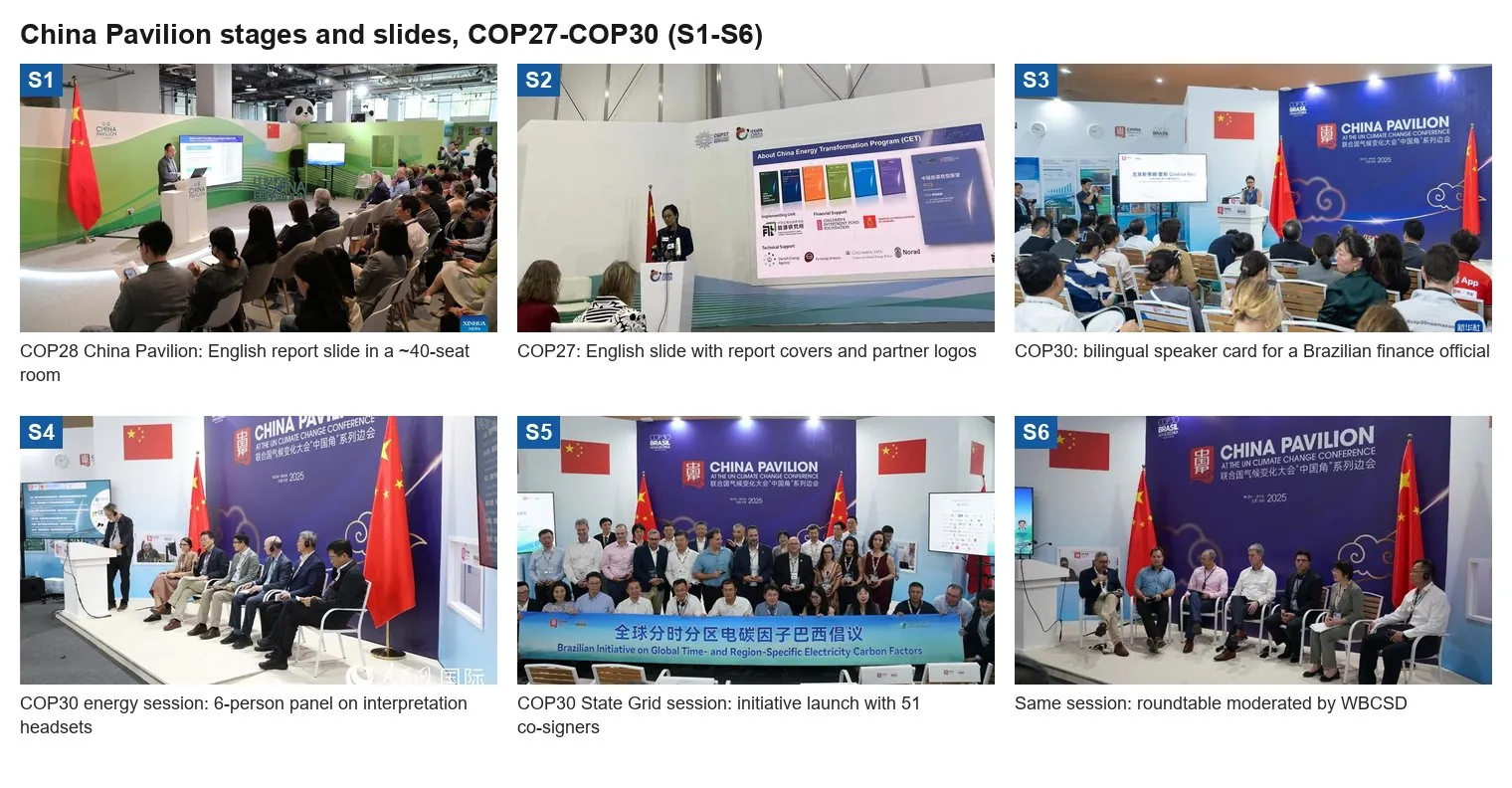
What these sessions show:
- A fixed template. Official remarks, then the company leader, then international keynotes, then a roundtable, then a release (report, initiative or MoU), then a group photo. A company speaker speaks inside that frame; it does not open the session.
- Coverage follows deliverables and foreign voices. Every well-covered case had a release and a speaker from IRENA, IEA, WBCSD or the host country. In Antalya the equivalent is a Turkish utility or regulator, or IHA or IRENA on hydropower.
- Rooms are small; the stream is large. One COP28 pavilion room held about 40 seats (S1). SPIC had about 80 people in the room and about 30,000 online.
- Interpretation existed at COP28. The China Pavilion used iFlytek simultaneous interpretation with live bilingual transcripts (People's Daily).
- Recurring weak spots: chart labels left in Chinese under English titles, non-native English on screen, and messages stated as priorities rather than data.
The one public China Pavilion deck: ERI at COP27
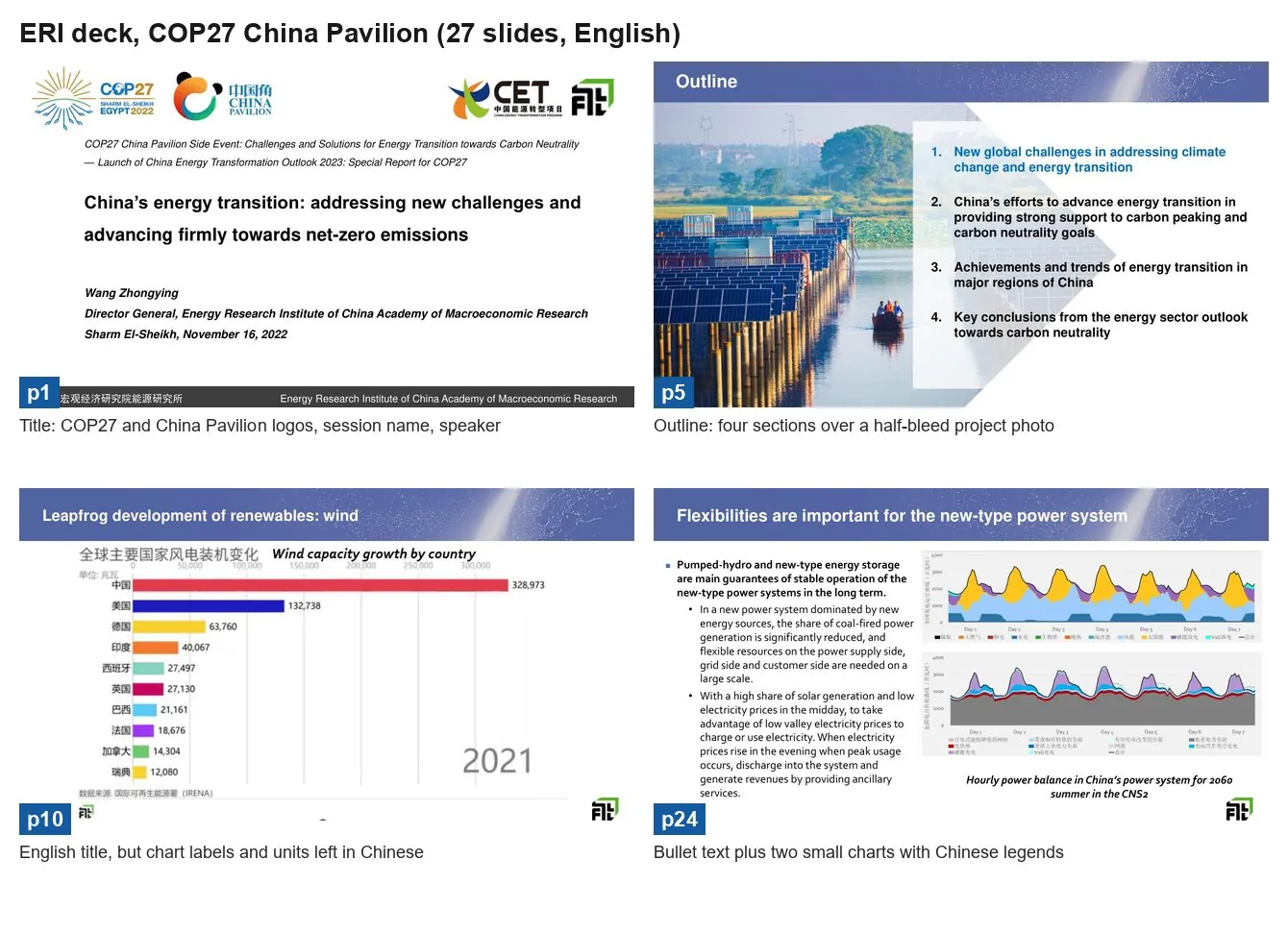
The Energy Research Institute's 27-slide English deck is the only complete China Pavilion deck found online (original PDF). It runs: title, institute introduction, a quotation, outline, global challenges, China's progress in charts, regional cases, 2060 scenarios, wrap-up. The structure is clean and the outline uses a strong project photo. But the charts keep Chinese labels, units and legends under English titles (p10, p24).
A template worth borrowing: the international case one-pager
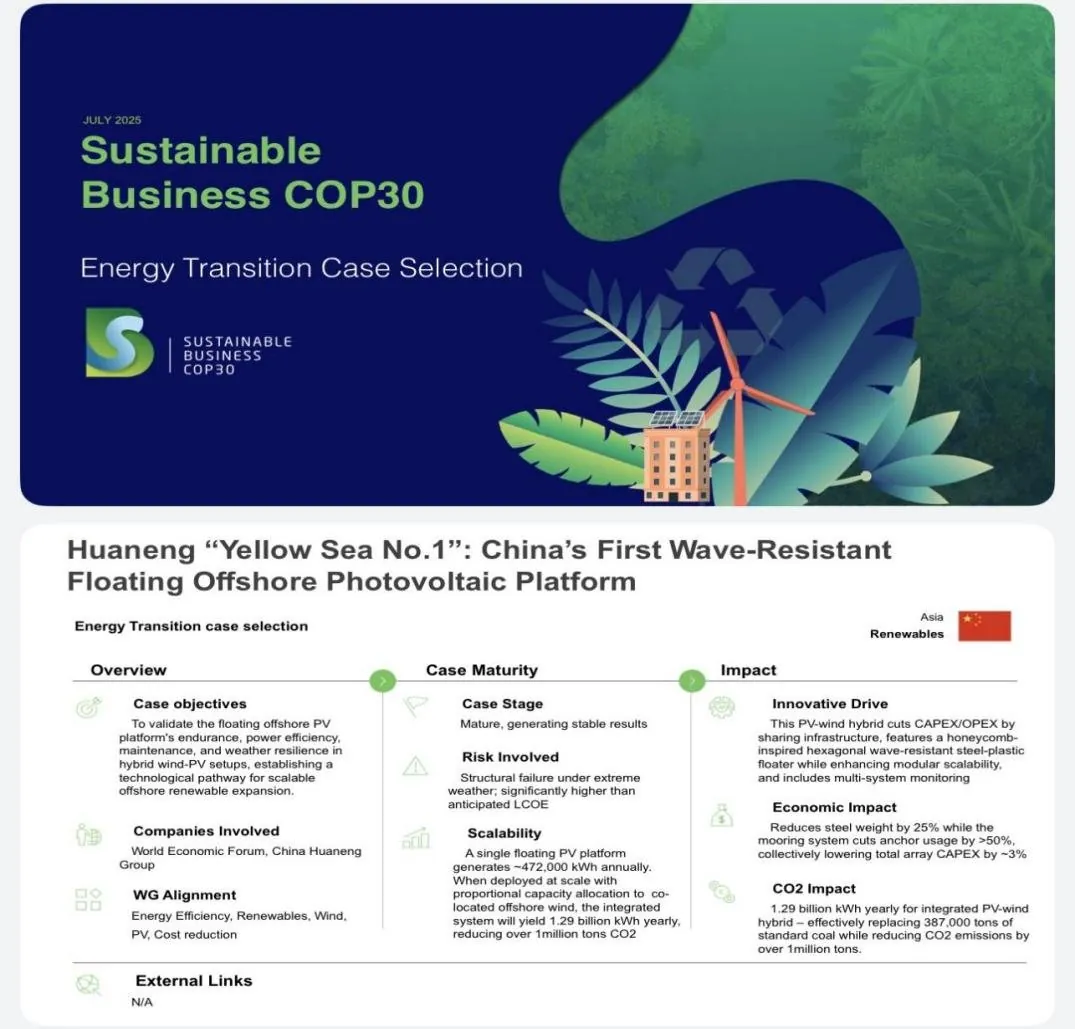
Huaneng's "Yellow Sea No.1" was the only Chinese case in the Sustainable Business COP30 energy-transition selection (The Paper). Its one-pager uses a fixed international template: objectives, partners, case stage, risk, scalability, innovation, economic impact and CO2 impact. It states the risk openly, which Chinese stage decks usually leave out. The same structure fits a hydro-wind-solar and ecology case, and can double as the handout.
International decks: what the strong ones share
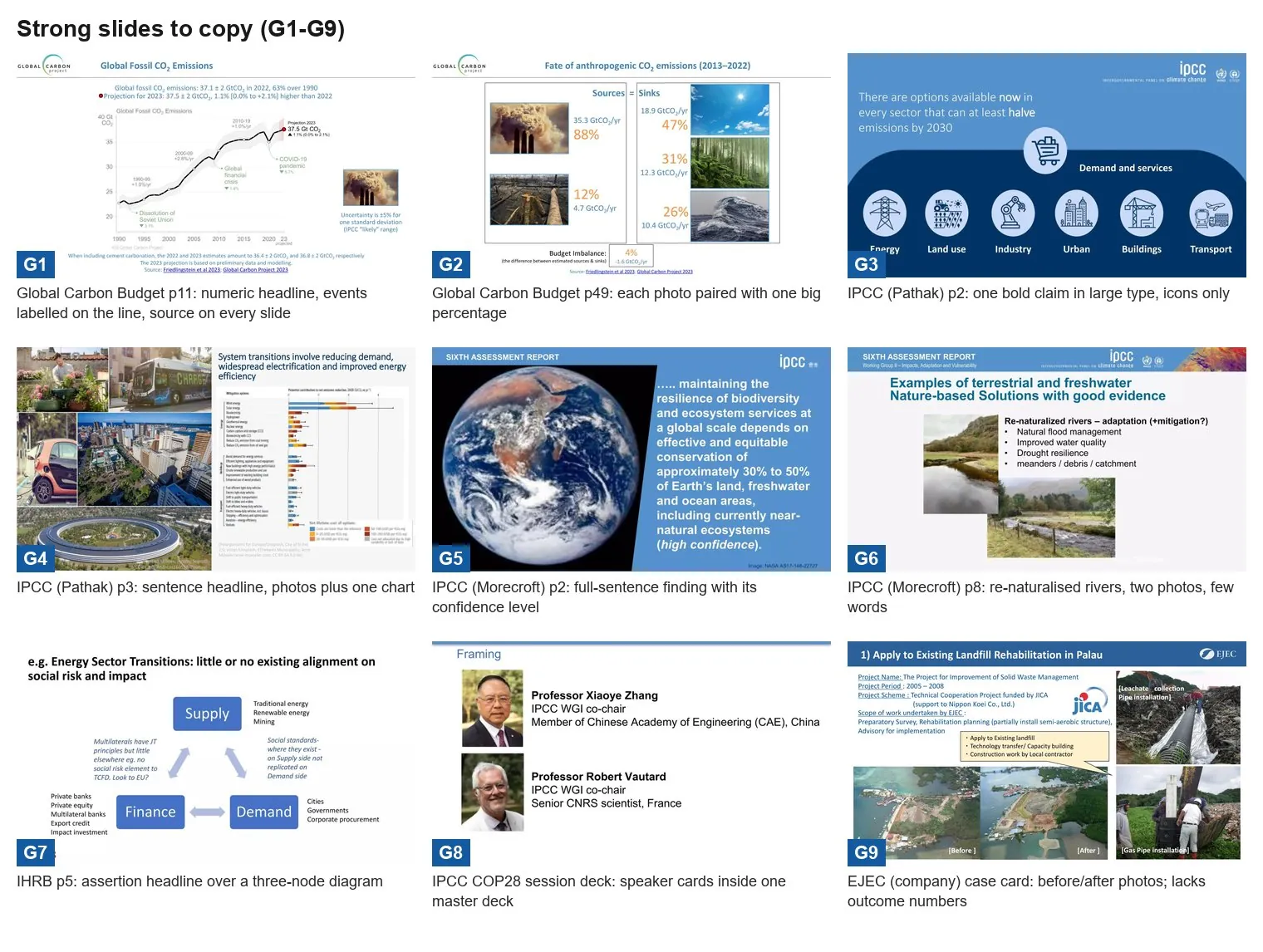
No hydropower deck from any COP is publicly downloadable: IHA and Itaipu publish only concept notes, agendas and recordings. The decks below are the closest real examples: science briefings on energy and rivers, one best-in-class data deck, and organisation and company decks. Links go to the original publishers.
Swipe the table sideways →
| # | Deck | Event | Slides | What to copy |
|---|---|---|---|---|
| G1, G2 | Global Carbon Budget 2023 | Released at COP28, 5 Dec 2023 | 94 | A topic title over one or two lines of hard numbers; events labelled on the chart; a source line on every slide |
| G3, G4 | IPCC energy system transitions (Pathak) | COP28 IPCC pavilion | 9 | Opens on one bold claim in large type: options exist "now in every sector" to "at least halve emissions by 2030" |
| G5 | IPCC freshwater ecosystems (Morecroft) | COP27 IPCC pavilion | 6 | Every headline a full sentence with its confidence level; one slide states the limits honestly |
| G6 | IPCC nature-based solutions (Morecroft) | COP27 IPCC pavilion | 14 | "Re-naturalised rivers" shown with two photos and four short lines |
| G7 | IHRB just energy transitions | COP27 IPCC pavilion | 6 | Sentence headlines, minimal branding, ends on concrete next steps |
| G8 | IPCC "Where is global warming…" | COP28, one 90-minute session | 30 | One master deck runs a multi-speaker session, with a speaker card for each segment |
| G9 | Eight-Japan Engineering Consultants | COP28 Japan Pavilion | 8 | The closest match to a company case talk: one card per project, before/after photos. Missing: measured outcomes |
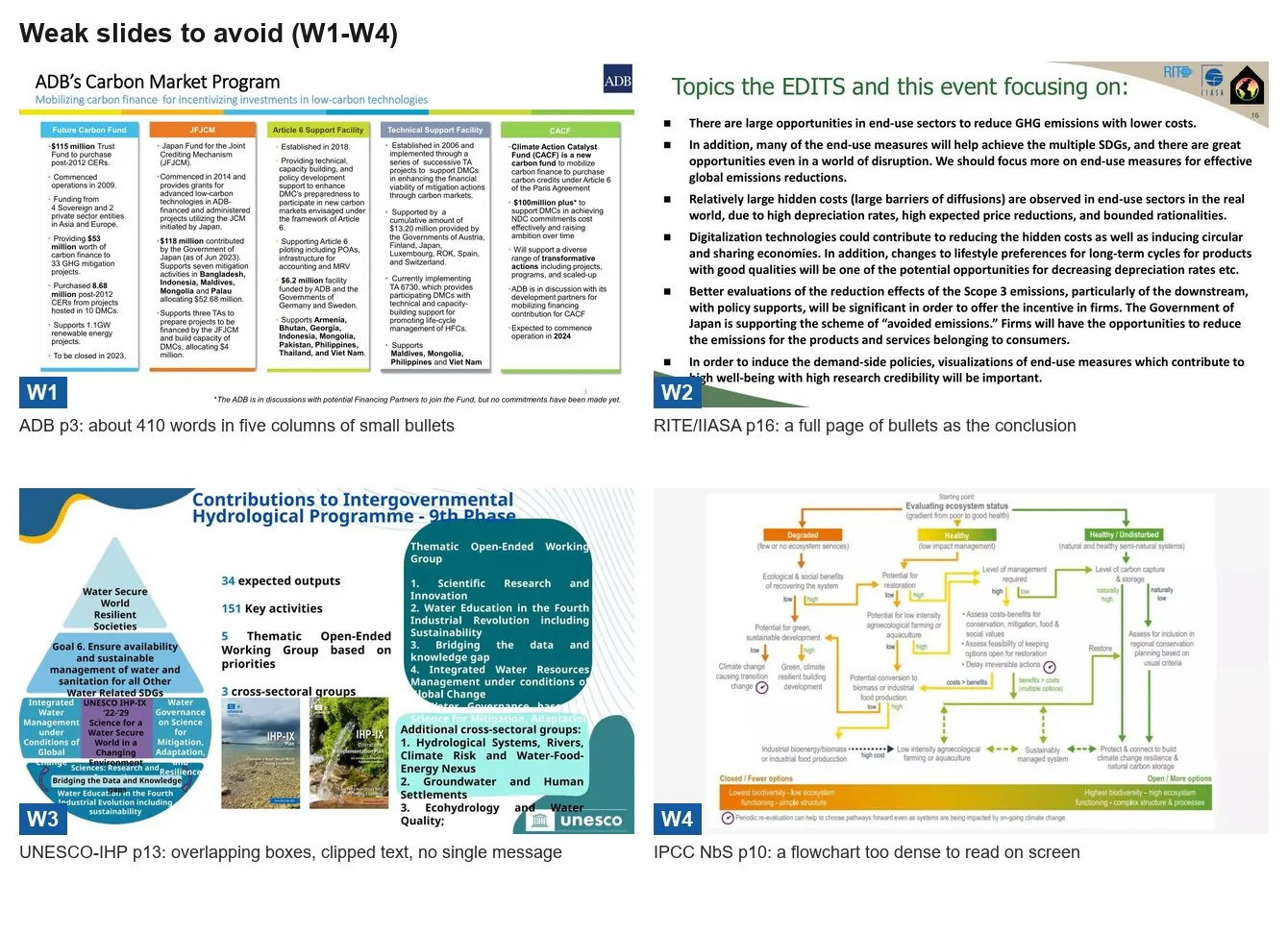
The weak decks fail in predictable ways. ADB's slide 3 carries about 410 words; the RITE/IIASA deck has a median of 132 words per slide; UNESCO's slide 13 overlaps boxes and clips text; an IPCC flowchart cannot be read from the room. None of the four ends with an ask.
What separates strong from weak, in five rules:
- One message per slide, stated as a sentence or a hard number.
- One chart or one or two photos per slide, labelled directly, with a source line.
- About 40 words of body text or fewer.
- The logo once in the master, not a stack on every slide.
- A measured outcome on every project card, and an offer or next step at the end.
Decks that are not posted after the event effectively disappear. The IPCC keeps every speaker's deck and recording on its outreach portal, and the UN asks side-event organisers to upload slides to SEORS (COP28 handbook). Post the final PDF on your English website as well.
04Recordings and key frames
There are full public replays of some China Pavilion sessions, but none was found for an energy company's session. The closest peer is CNPC's 2.5-minute English recap of its COP30 central-SOE session (A5). All links were opened and checked on 16 Oct 2026.
Watching from China: Bilibili copies
Six of the 25 recordings have a Bilibili copy, and Kofe's speech has one as news excerpts. The other 18 have no Bilibili copy; the key frames at the end of this section cover them.
Swipe the table sideways →
| # | Bilibili link | Length | Subtitles | Match |
|---|---|---|---|---|
| A4 | BV1np4y1d7v1 | 4:01 | Chinese, burned in | Full |
| A6 | BV1Em4y1F7hr | 6:08 | Chinese and English, burned in | Full |
| A7 | BV1reUHBJEZy | 20:07 of 23:55 | Chinese broadcast | Trimmed re-upload |
| B8 | BV1jsUAYPErX | 3:18:14 | Machine-translated Chinese | Full; held in the China Pavilion at the biodiversity COP16, slides visible |
| C1 | BV1cg411P7WY | 8:06 of 8:20 | English only | Full speech |
| C2 | BV1zL41177iF | 7:26 | Chinese and English, burned in | Full; the best subtitled option |
| C4 | BV1UU4y1g7zX | 1:11 | Chinese captions | News excerpt |
Bilibili has no replay of any energy-company China Pavilion session and no hydropower COP session.
China Pavilion and Chinese speakers
Swipe the table sideways →
| # | Recording | COP | Length | Language | Watch for |
|---|---|---|---|---|---|
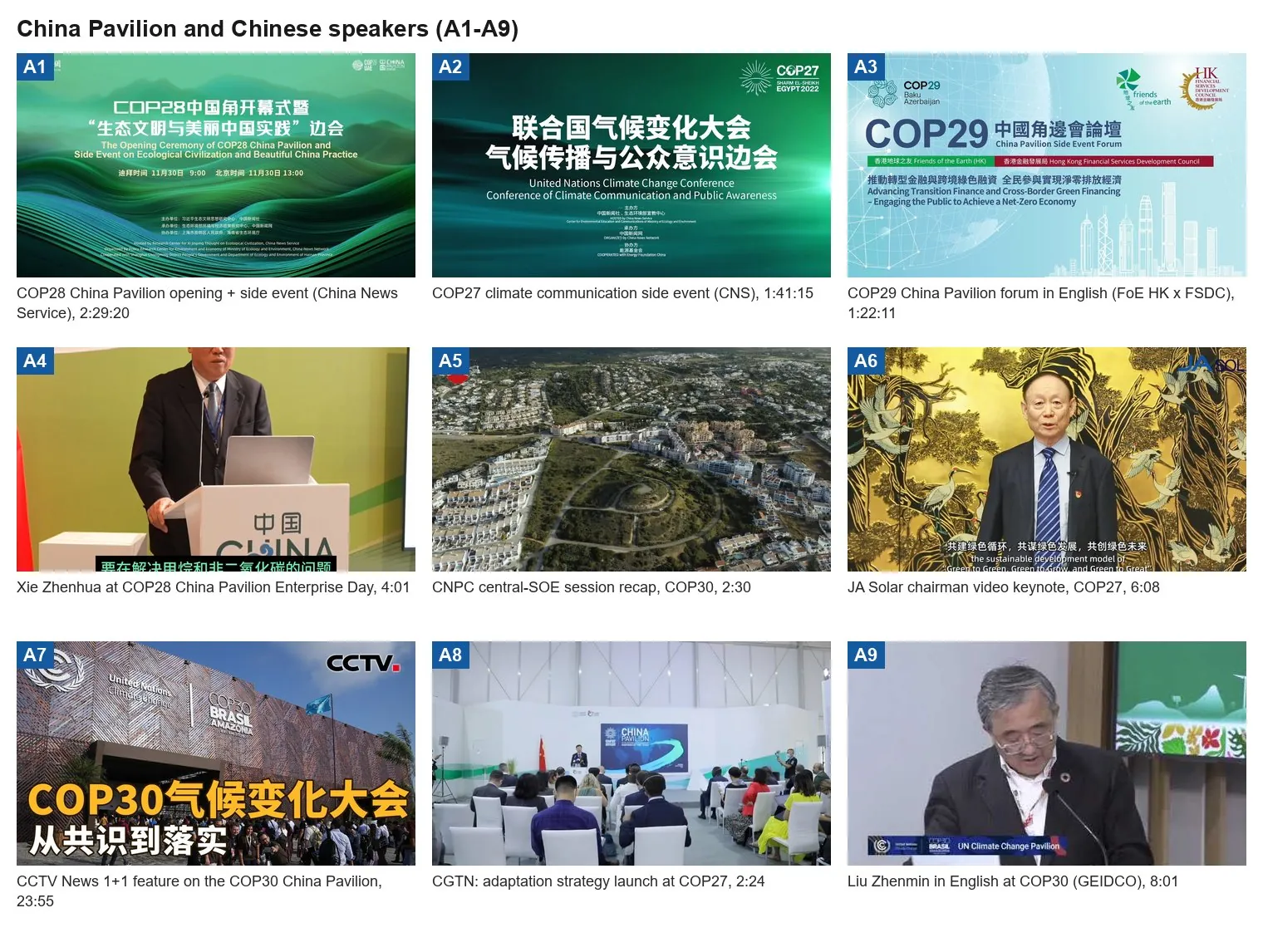
| A1 | COP28 China Pavilion opening and side event (China News Service) | COP28, 30 Nov 2023 | 2:29:20 | Chinese | The standard format: lectern speeches filmed by one fixed camera. Note the protocol time and who looks up from the text |
| A2 | Climate communication and public awareness side event (CNS) | COP27, Nov 2022 | 1:41:15 | Chinese | Slides behind standing presenters, then a 4-person panel; the topic is how Chinese actors communicate climate action |
| A3 | FoE HK × FSDC China Pavilion forum | COP29, Nov 2024 | 1:22:11 | English | One of very few full English China Pavilion recordings; how a Chinese host runs an English panel |
| A4 | Xie Zhenhua at the COP28 Enterprise Day (Bilibili) | COP28, Dec 2023 | 4:01 | Chinese | The official framing a company talk builds on: renewables passing coal, PV and EV industries, lower global costs |
| A5 | CNPC central-SOE session recap | COP30, 19 Nov 2025 | 2:30 | English | Closest peer; the kind of English recap a company can publish the same week |
| A6 | JA Solar chairman's video keynote (Bilibili) | COP27, Nov 2022 | 6:08 | Chinese, bilingual subtitles | A fallback if an executive cannot travel; a three-part slogan as the memory hook |
| A7 | CCTV News 1+1 on the COP30 China Pavilion | COP30, 19 Nov 2025 | 23:55 | Chinese | What domestic TV takes from the pavilion; prepare one 10–15 second Chinese soundbite |
| A8 | CGTN: adaptation strategy launch | COP27, 10 Nov 2022 | 2:24 | English | A document launch gives media a news hook |
| A9 | Liu Zhenmin speaking in English (GEIDCO) | COP30, Nov 2025 | 8:01 | English | A senior official reading closely from text; compare eye contact with C1–C3 |
International sessions on hydropower, renewables, water and nature
Swipe the table sideways →
| # | Recording | COP | Length | Watch for |
|---|---|---|---|---|
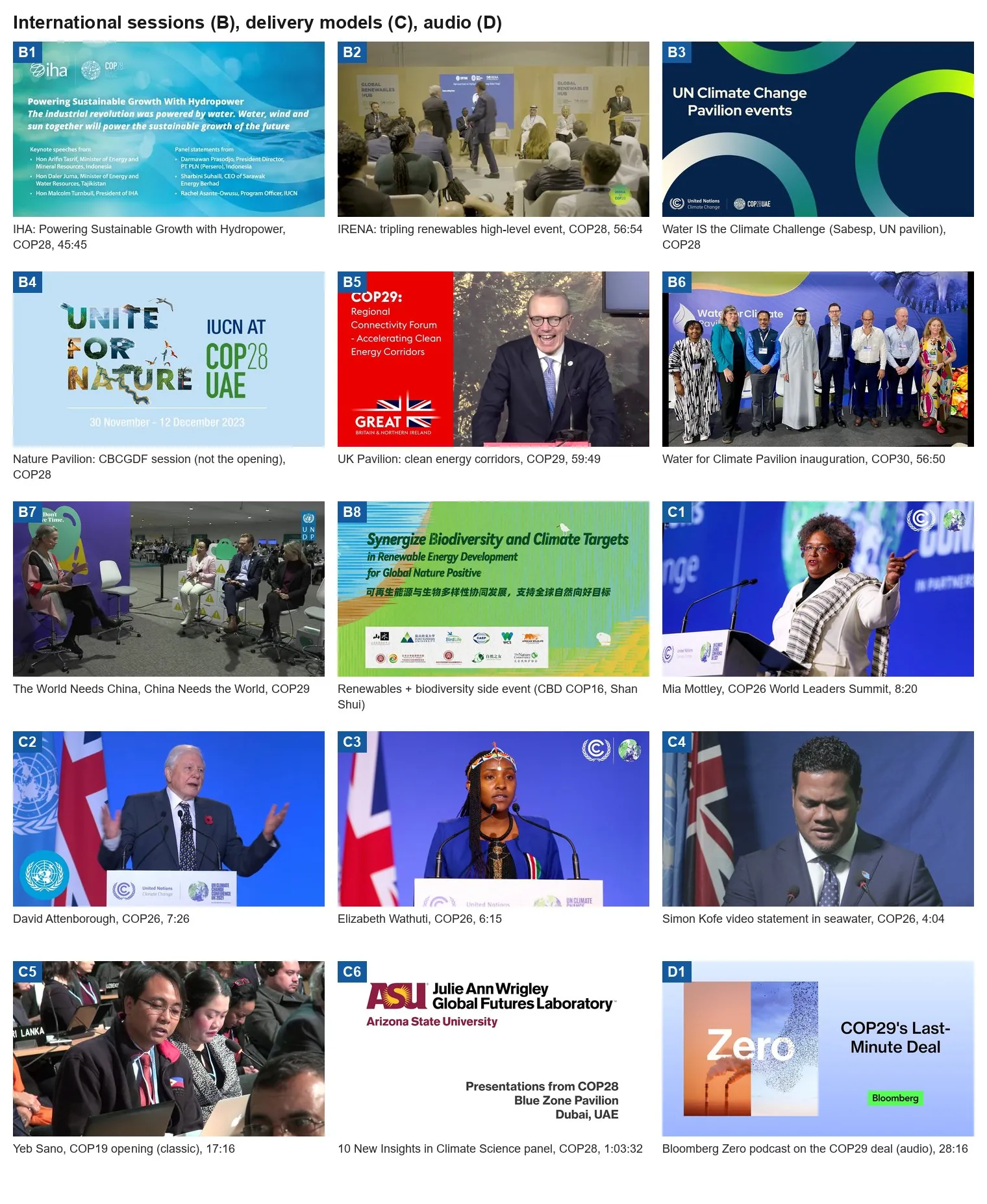
| B1 | IHA: Powering Sustainable Growth with Hydropower, Indonesia Pavilion | COP28, 3 Dec 2023 | 45:45 | The only hydropower-specific recording found. Ministers, utility CEOs and IUCN share one panel. Its title card reads: "Water, wind and sun together will power the sustainable growth of the future." |
| B2 | IRENA: tripling renewables high-level event | COP28, 2 Dec 2023 | 56:54 | The tripling-renewables frame a hydro-wind-solar base fits into. One wide camera, so words carry the talk |
| B3 | Water IS the Climate Challenge (Sabesp, UN Climate Change Pavilion) | COP28, Dec 2023 | 1:28:16 | A utility hosting a multi-stakeholder panel and giving partners the floor |
| B4 | Nature Pavilion session by a Chinese foundation (CBCGDF) | COP28 | 40:50 | Not the IUCN opening, as labelled: a session on bird protection on power lines. Right topic, weak delivery: a slide shown in a browser window, Chinese-only screens, about 8–10 people |
| B5 | UK Pavilion: clean energy corridors | COP29, 14 Nov 2024 | 59:49 | Polished multi-camera, hybrid production on cross-region power integration |
| B6 | Water for Climate Pavilion inauguration (SIWI) | COP30, Nov 2025 | 56:50 | The water community's flagship pavilion; a possible partner venue at COP31 |
| B7 | The World Needs China, China Needs the World | COP29, 16 Nov 2024 | 1:16:54 | How international media frame China: top emitter and top clean-tech producer. Expect this framing in Q&A |
| B8 | Renewables and biodiversity side event (Shan Shui, Bilibili) | Biodiversity COP16, 2024 | 3:18:14 | The most on-topic content found for renewables plus biodiversity. Watch for terminology. Not a climate COP |
Delivery models
Swipe the table sideways →
| # | Recording | COP | Length | Watch for |
|---|---|---|---|---|
| C1 | Mia Mottley, World Leaders Summit | COP26 | 8:20 | Pauses before key lines; she looks at the hall, not the text |
| C2 | David Attenborough (Bilibili, subtitled) | COP26 | 7:26 | One rising CO2 series carries the whole talk, cut with full-screen footage. No bullet slides |
| C3 | Elizabeth Wathuti | COP26 | 6:15 | Personal story first, then the ask. One local detail carries a global message |
| C4 | Simon Kofe video statement | COP26 | 4:04 | Recorded knee-deep in seawater. One staging decision made a side-event video famous |
| C5 | Yeb Saño | COP19, 2013 | 17:16 | A seated, read statement still holds the room because it is first-person and specific |
| C6 | 10 New Insights in Climate Science panel (ASU) | COP28 | 1:03:32 | A warning: dense text slides are illegible on camera |
Audio only:
- D1 Bloomberg Zero: COP29's last-minute deal (28:16) — how the international press explains a COP in plain language.
- D2 ECFR In:Sight China with Liu Hongqiao (COP27) — how European China-watchers read Chinese climate messaging; useful for Q&A prep.
What the recordings show
- Slides rarely reach the replay. China Pavilion streams use one fixed camera on the lectern, so side-screen slides are not seen online. Say every key number aloud.
- Online reach is small. China Pavilion replays have 85–600 views, against 684,186 for Mottley and over one million for a Guardian clip of Kofe. The room, state-media packages and the company's own short recap reach more people.
- Language is shifting to English. The COP27–28 China News Service replays are in Chinese; the COP29 forum and the COP30 CNPC recap are in English.
- The famous talks are 4–9 minutes, use no slides and hang on one anchor: a number, a place or a single image.
- COP31 sessions will likely appear on the presidency's "COP31 Türkiye" YouTube channel, which already streamed an IEA energy-transition dialogue in April 2026.
Key frames
These 67 frames capture the moments worth studying, so you can learn from them without opening YouTube. Each timestamp links straight to that moment. Frames were captured from the streams on 16 Oct 2026.
China Pavilion and Chinese speakers
Swipe the table sideways →
| # | Moments | What they teach |
|---|---|---|
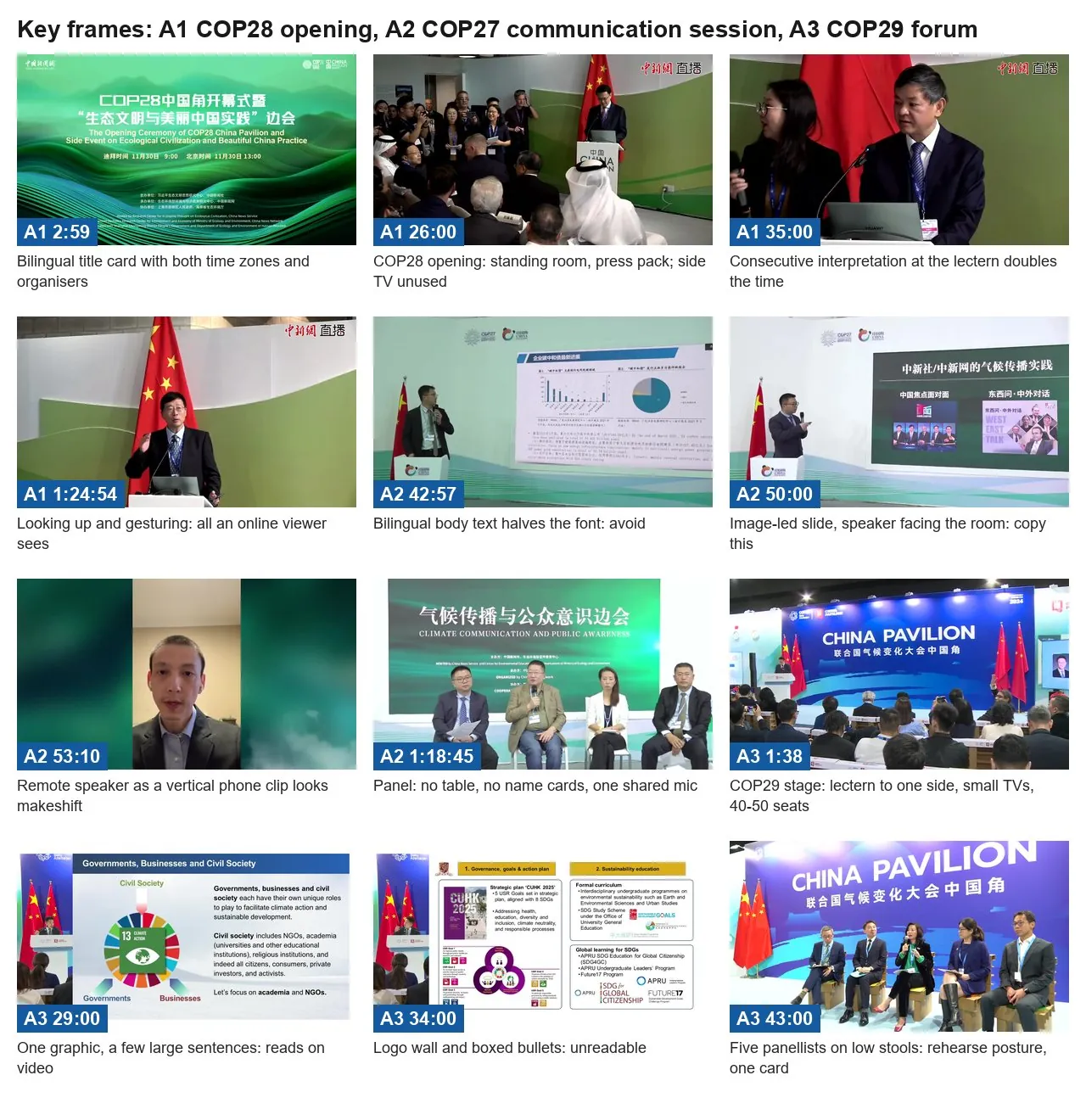
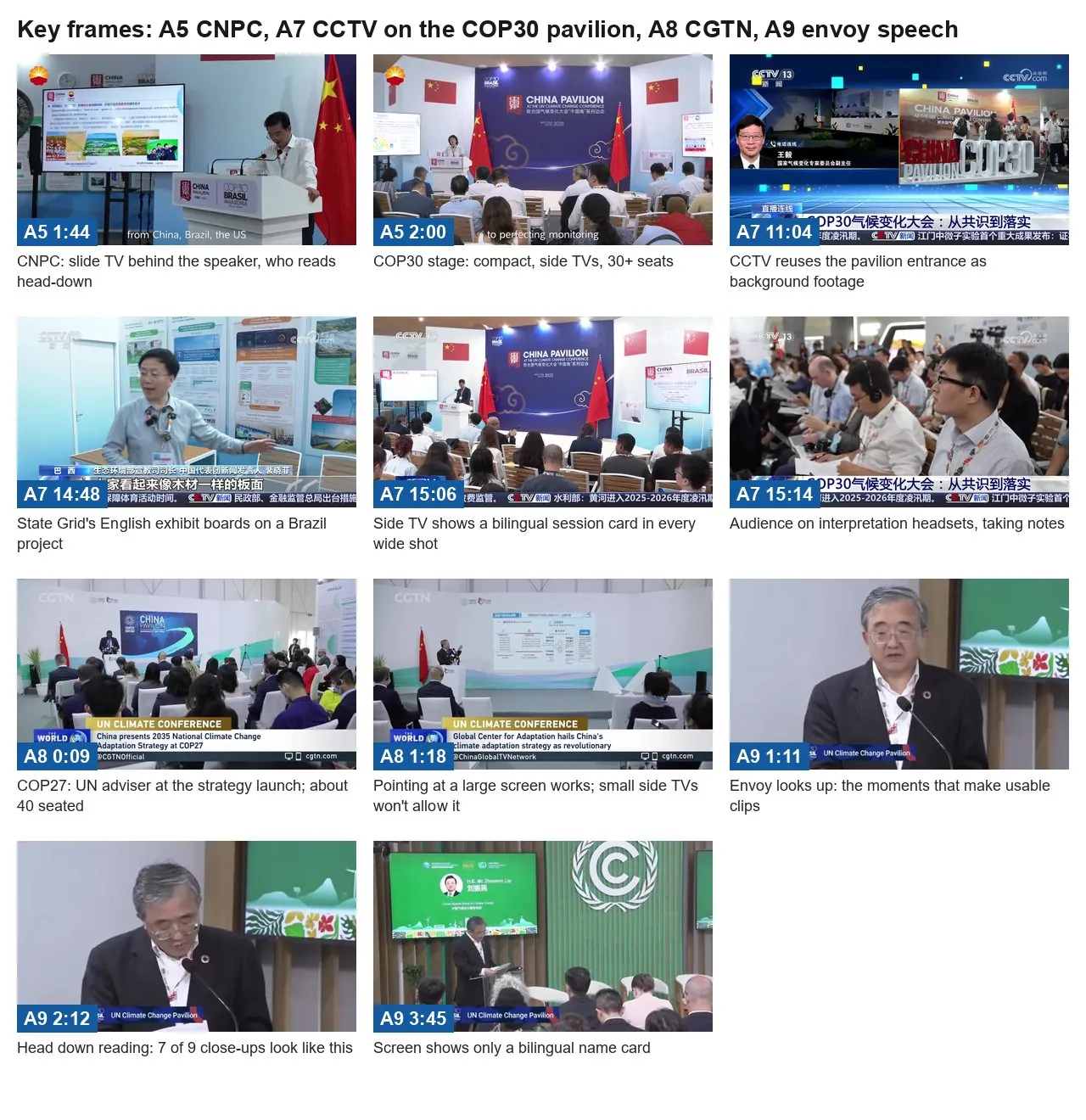
| A1 | 2:59 · 26:00 · 35:00 · 1:24:54 | The livestream never shows the screen, so eye contact is all online viewers get. Consecutive interpretation doubles the time each point takes |
| A2 | 42:57 · 50:00 · 53:10 · 1:18:45 | An image-led slide reads; bilingual body text does not. A vertical phone clip looks makeshift. Panels have no table and one shared mic |
| A3 | 1:38 · 29:00 · 34:00 · 43:00 | Screens are small side TVs. One graphic with a few sentences works; a logo wall does not. Panellists sit on low stools |
| A5 | 1:44 · 2:00 | The slide TV sits behind the speaker, so the speech must carry the argument |
| A7 | 11:04 · 14:48 · 15:06 · 15:14 | State Grid's English exhibit boards feature a host-country project. A bilingual session card names the session in every wide shot. The audience uses headsets |
| A8 | 0:09 · 1:18 | A launch with a UN voice on stage gave CGTN its headline. Pointing at the slide only works with a big screen |
| A9 | 1:11 · 2:12 · 3:45 | Looking up makes usable clips; reading head-down (7 of 9 close-ups) does not |
International sessions
Swipe the table sideways →
| # | Moments | What they teach |
|---|---|---|
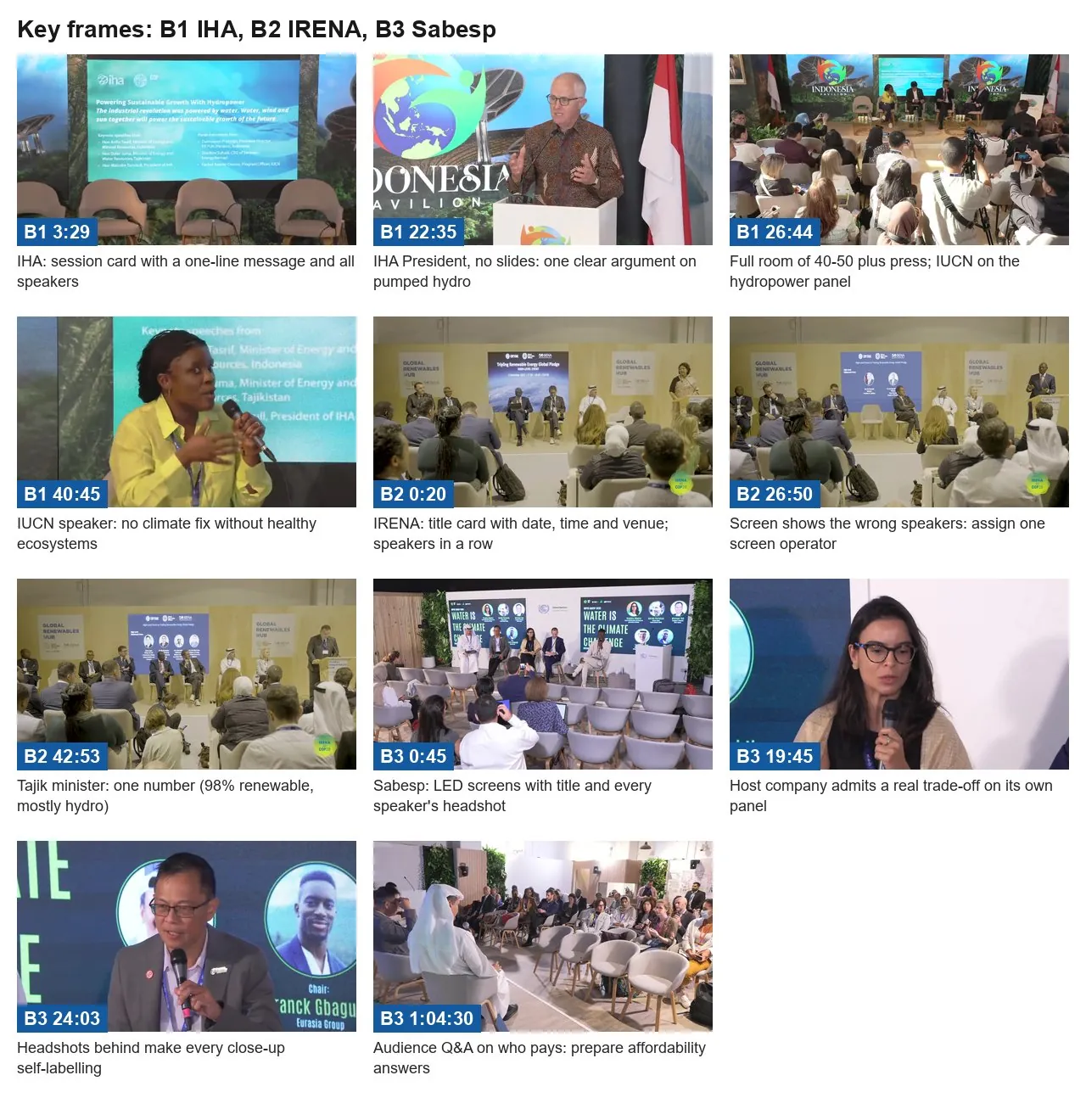
| B1 | 3:29 · 22:35 · 26:44 · 40:45 | One session card with a quotable line and every speaker. An IUCN voice on the hydropower panel adds credibility |
| B2 | 0:20 · 26:50 · 42:53 | Put date, time and venue on the title card. The screen showed the wrong speakers: assign one operator. A hydropower country lands its point with one number |
| B3 | 0:45 · 19:45 · 24:03 · 1:04:30 | Headshots on screen label every close-up. The host company admits a trade-off. Expect affordability questions |
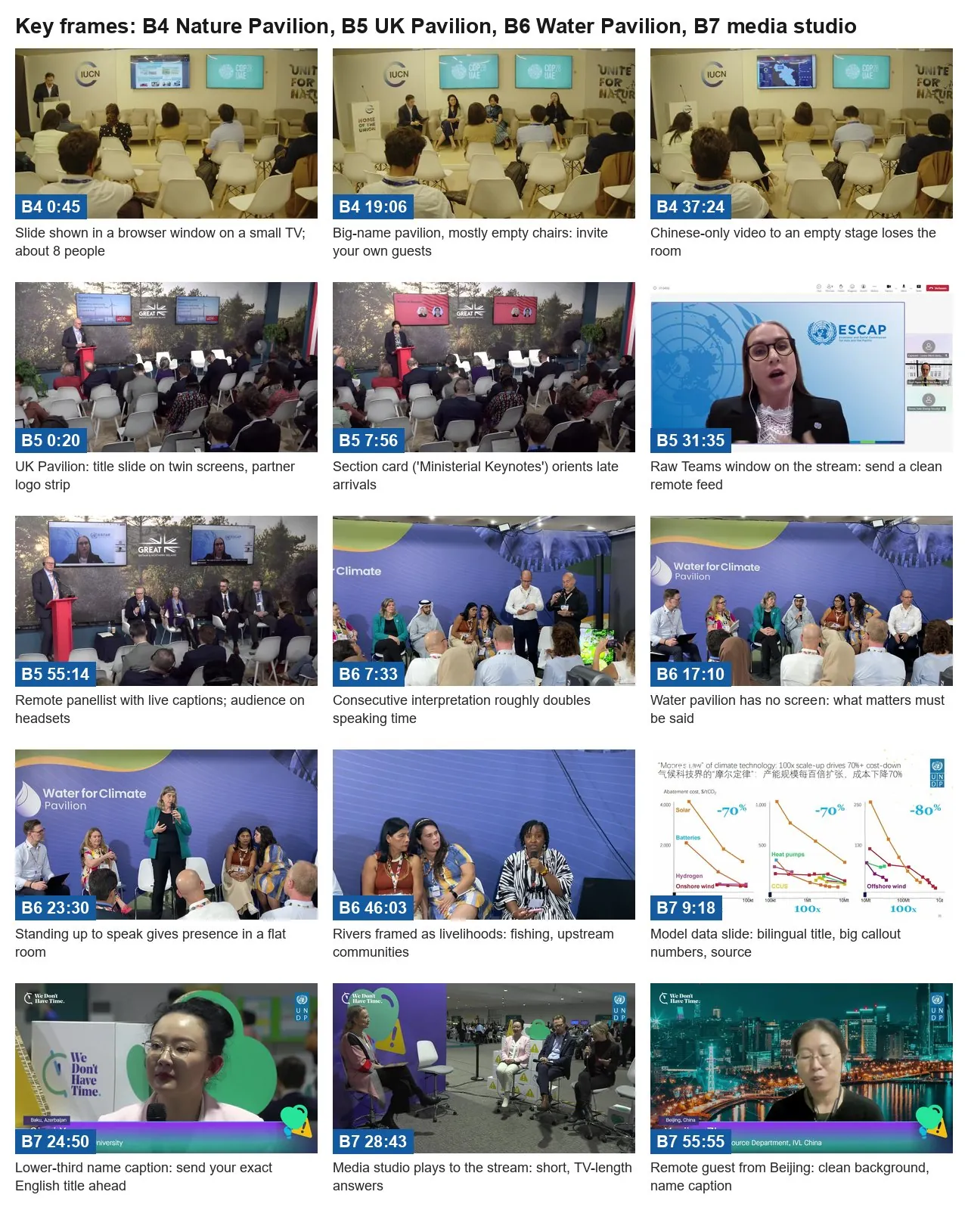
| B4 | 0:45 · 19:06 · 37:24 | What to avoid: a slide in a browser window, Chinese-only video, about 8 people in the room |
| B5 | 0:20 · 7:56 · 31:35 · 55:14 | Section cards orient late arrivals. Send a clean remote feed, not a raw Teams window. Live captions help |
| B6 | 7:33 · 17:10 · 23:30 · 46:03 | No screen at all: what matters must be said. Rivers are framed as livelihoods |
| B7 | 9:18 · 24:50 · 28:43 · 55:55 | The model bilingual data slide. Send your exact English name and title for the caption |
Delivery models
Swipe the table sideways →
| # | Moments | What they teach |
|---|---|---|
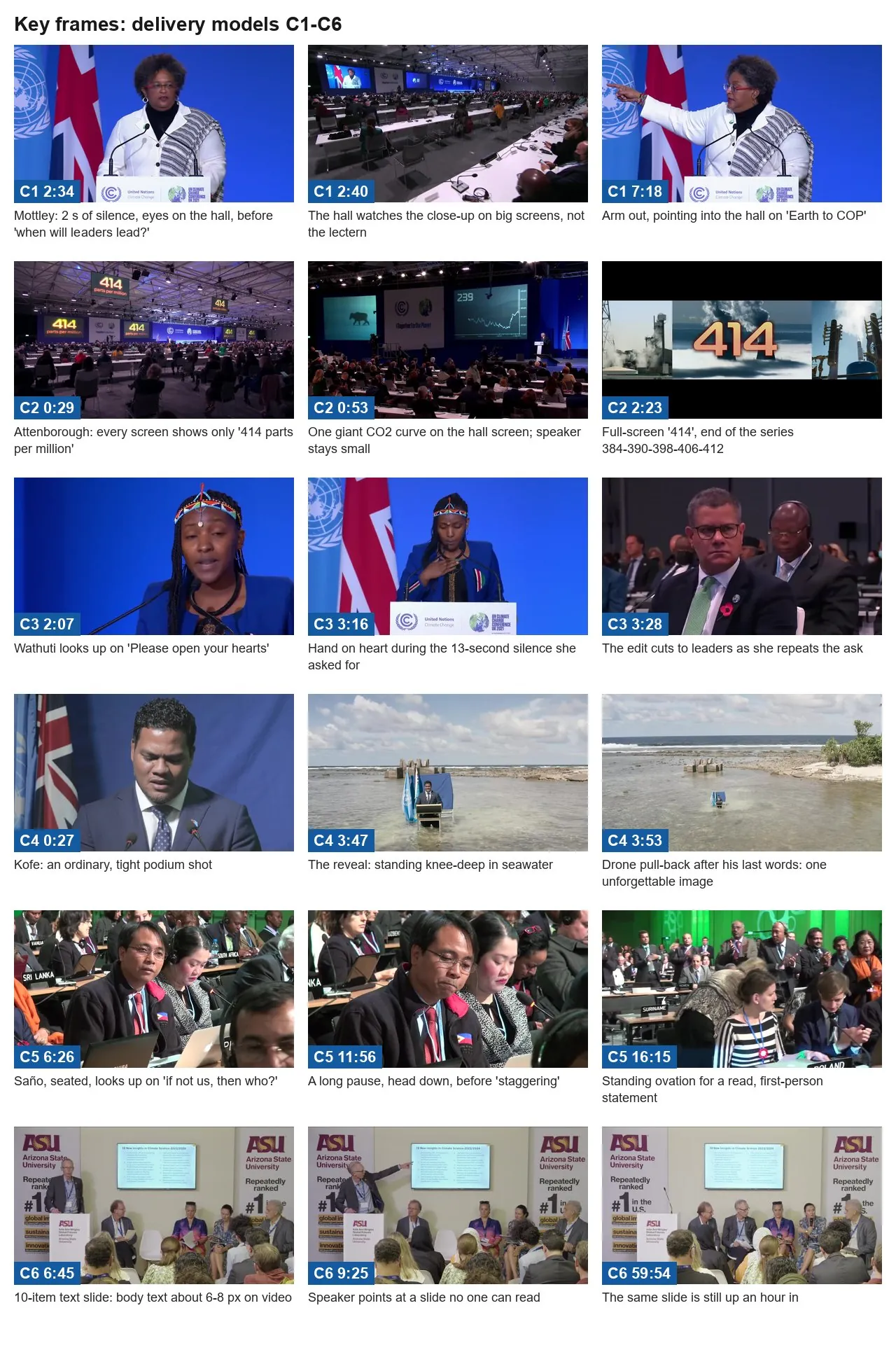
| C1 | 2:34 · 2:40 · 7:18 | Two seconds of silence before the key line; the hall watches the close-up on screen |
| C2 | 0:29 · 0:53 · 2:23 | One number on every screen (414 ppm) and one rising series carry the talk |
| C3 | 2:07 · 3:16 · 3:28 | She asks the hall for 13 seconds of silence; the edit cuts to the leaders |
| C4 | 0:27 · 3:47 · 3:53 | An ordinary podium shot, then the seawater reveal at the end |
| C5 | 6:26 · 11:56 · 16:15 | A seated, read statement earns a standing ovation because it is first-person and specific |
| C6 | 6:45 · 9:25 · 59:54 | A 10-item text slide stays unreadable on camera for an hour |
05Best practices and lessons
The decks that work at COP make one claim per slide, back it with checkable data, and tie it to global goals rather than domestic slogans.
Slide design for a pavilion room
- One claim per slide. Write each headline as a full sentence that states the point, e.g. "The base avoids X million tonnes of CO2 a year." Back it with one chart or one photo. In Penn State studies, audiences shown these "assertion-evidence" slides understood and remembered more (Penn State research).
- Big type, little text. Body text 24–28 pt or larger, headlines 36–40 pt, about 30 words of running text per slide. Use dark text on a light background in brightly lit pavilions (W3C accessible presentations).
- Expect a small, noisy room. The Canada Pavilion at COP31 seats about 25, runs 45-minute events with 4–5 speakers, and shows two screens in two languages (Canada Pavilion FAQ).
- Photos: 1–2 per slide, real and sharp (at least 1920 px wide for a full-bleed image). Show the work itself: a fishway, a revegetated slope with before/after, a technician at work. Never alter what a photo documents, and label renderings "illustrative".
- Charts: one message each. Label lines directly, spell out units (t CO2/yr, GW, TWh; no 万/亿), highlight the one series that matters, and skip 3D, dual axes and many-slice pies.
- Maps: one simple locator map on the official standard base map. Describe the site functionally, e.g. "a high-mountain river basin in western China".
- Logos on the title and closing slides only. A logo wall on every slide reads as promotional.
- English-first slides. With one screen, add at most a small Chinese line under the headline. Never set two full languages side by side. Give interpreters both versions.
Story and framing
At COP30 the best-attended China Pavilion events were on south–south cooperation; visitors came to learn how a developing country runs its energy transition (Carbon Brief, 13 Nov 2025). At a COP28 China Pavilion session, Chinese communicators themselves said their stories are too technology-only, should explain why, and should not tell others what to do (The Paper, 8 Dec 2023).
A 10-minute arc that follows this advice:
- 0–1 min — The answer. What the base delivers for the climate, in one sentence and one number.
- 1–3 min — Why this design. Why hydro, wind and solar together: hydropower balances variable wind and solar.
- 3–5 min — Results. Generation, avoided CO2 with its method, construction-phase savings, one relatable equivalent.
- 5–8 min — Protecting the river and the land. Two or three measures, each with monitoring data on outcomes.
- 8–9 min — What others can reuse. The transferable model, including one thing you would do differently.
- 9–10 min — The invitation. Data sharing, partnerships, a site visit, the QR code.
Replace domestic terms with plain international English:
| Chinese term | Say instead |
|---|---|
| 双碳 | China's goals to peak CO2 before 2030 and reach carbon neutrality before 2060 |
| 水风光一体化 / 多能互补 | Integrated hydro-wind-solar base; hydropower balances variable wind and solar |
| 增殖放流 | Releasing hatchery-reared native fish (stocking) |
| 鱼道 / 过鱼设施 | Fishway / fish pass |
| 生态流量 | Environmental flows |
| 植被恢复 | Revegetation / habitat restoration |
| 标准煤 | Convert to tonnes of CO2 |
| 万 / 亿 | Thousands, millions, billions; or TWh |
| 生态文明, 绿水青山…, 高质量发展 | Drop, or explain the idea in one plain sentence |
For relatable equivalents, US EPA factors are a common reference: 4.29 t CO2e per passenger car per year, 7.45 t per US home's energy use per year (EPA calculator). Use one equivalent, not a stack, and label it approximate.
Credibility: what observers check
NGOs and journalists judge corporate claims against the UN expert group report Integrity Matters (2022): actions not announcements, absolute numbers not only intensity, published data, and independent third-party verification (UN HLEG report). Build the deck to pass that test:
- Footnote every headline number with method, baseline, year and verifier.
- Call avoided emissions "avoided emissions". Never net them against your own footprint or call the base "zero-carbon".
- Show outcome data for each ecological measure, e.g. fish species and counts passing per year, vegetation cover before and after.
- Add one line on what you are still improving. It earns more trust than an all-positive deck.
- Offer the full monitoring or ESG report via a QR code.
- Avoid "zero emissions", "no ecological impact", "fully restored", "perfect harmony" and unverified "world-first / world-leading".
Hydropower draws specific scrutiny. The IPCC median life-cycle intensity is 24 g CO2e/kWh, but reservoir emissions are highest in the first 10–20 years after filling (IHA factsheet). A review of fishway studies found mean passage efficiency of about 40–70% depending on type (Bunt et al. 2012). So observers want monitoring numbers, not the existence of a fishway.
Hard questions to rehearse
Answer pattern: acknowledge the concern, give the number and method, name the verifier or report, offer a follow-up. Keep each answer to 30–60 seconds and never debate national policy.
Swipe the table sideways →
| Likely question | Answer with |
|---|---|
| Reservoirs emit methane. Is your hydropower really low-carbon? | The project's measured or modelled g CO2e/kWh against the IPCC median of 24; your monitoring plan |
| Fishways often fail. How many fish actually pass? | Species, counts and years from monitoring; the method and partner; stocking as a complement to habitat, not a substitute |
| Who verified your emission reductions, against what baseline? | The methodology, grid emission factor and verifier; avoided emissions reported apart from your footprint |
| Your group still runs coal plants. Isn't this greenwashing? | The group's transition facts, prepared in advance, stated briefly without deflecting |
| What about cumulative impacts on the river? | Basin-level planning, environmental flows, connectivity measures, monitoring; acknowledge the trade-off |
| Were local communities consulted, and are they better off? | The consultation process, benefit-sharing figures, grievance mechanism; offer to connect if outside your remit |
| Is the project certified to an international standard? | The standards that apply; whether you are open to independent assessment; no overclaiming |
| Wind and solar curtailment is high. Does integration work? | Utilisation and curtailment rates, and how hydro balancing changed them |
Delivery and interpretation
- Slides to time: 8–10 content slides for 10 minutes, 12–14 for 15 minutes.
- Script length: about 1,000–1,200 words for 10 minutes when interpreted, roughly 110–130 words a minute. This rate is an estimate from interpreters' guidance (AIIC speaker guidelines).
- Language: speak English only if fluent; otherwise speak Chinese with interpretation and open and close with two rehearsed English sentences. Announce any language switch (EC interpretation service tips).
- Interpreters: send slides, script, a 20–40 term glossary and name pronunciations 3–5 days ahead. Booths are often far from the screen (AIIC).
- Sentences: short, one number per sentence, numbers said clearly. Speak rather than read; reading speeds you up (AIIC).
- Rehearse three times, once in front of a non-Chinese listener to catch jargon. Cut whatever overruns; the moderator will cut you anyway.
06COP31 checklist
COP31 runs 9–20 Nov 2026 at the Antalya Expo Center, and opened on 9 November. If you have not spoken yet, the last steps are to confirm the session format with the organiser, lock the numbers and their methods, and get the English professionally reviewed.
Key dates
| Date | What | Why it matters |
|---|---|---|
| 9 Nov | COP31 opens | One Blue Zone entrance with 30 checkpoints for about 100,000 participants: expect queues |
| 10 Nov | Energy and Transport day | The natural hook for a clean-energy story. At COP30 the UN put topic side events on the days before and after its thematic day |
| 11–12 Nov | Leaders' Summit | Heaviest security; avoid tight arrival times |
| 17 Nov | Ocean, Seas, Nature and Land Use day | A second hook for the river and habitat story |
| 20 Nov | Final negotiations, close | — |
Sources: cop31.tr programme overview, Trend.az on the venue, COP30 side-event handbook.
Türkiye is on UTC+3, five hours behind Beijing, so a 10:00 session in Antalya is 15:00 for a livestream audience in China. The free COP31 e-Visa is multiple-entry, valid 1–30 Nov, and takes up to 7 working days. Passports need 90 days' validity after arrival, and travel insurance is mandatory (cop31.tr visa and entry).
Preparation roadmap
T is your speaking day; each phase is counted back from it. China Pavilion session dates are in the schedule handbook above.
- Now · T−3 weeksConfirm and lockFormat with the organiser · headline numbers and their methods · e-Visa
- T−2 weeksBuildDeck and script · professional English review · sensitivity pass
- T−1 weekRehearseThree timed run-throughs · Q&A drill · handout and QR landing page
- T−3 daysHand overInterpreter pack (slides, script, glossary) · files on two USB sticks and the cloud
- Day TSpeakArrive early · 15-minute tech check · your own camera on the speaker
- T+2 days to T+1 weekFollow upPublish deck and recap within 48 hours · follow-up emails · track results
Finish everything except the talk itself three days before you speak.
Checklist
Ticks are saved only in your own browser.
Confirm with the organiser
Content
Slides and files
Interpretation and delivery
Outreach
On the day
After
07Key sources
- UN side-event organiser handbooks: COP26, COP27, COP28, COP29, COP30
- COP31: programme overview, Blue Zone, visa and entry
- China Pavilion: MEE on COP29, MEE on COP30, COP28 schedule notice, Carbon Brief COP30 China briefing, The Paper on climate communication
- Credibility: UN HLEG Integrity Matters, IHA reservoir emissions factsheet, Bunt et al. 2012 on fishways
- Presenting and interpretation: AIIC speaker guidelines, EC interpretation tips, W3C accessible presentations, Penn State assertion-evidence research, Canada Pavilion FAQ, Finland Pavilion organiser guidance
- Deck archives: IPCC outreach portal, Global Carbon Budget 2023
Images on this page are screenshots and composites from public recordings and decks, used for commentary and learning; rights remain with their owners. To raise a concern, write to raymond@gitechdesign.com.