Who Should Review Whom?
Response-conditioned disassortative peer review for test-time LLM reasoning
Rui Li · Chenglong Sun · Xueyan Zheng · Dan Liu
Gi (Beijing) Tech Design Ltd. · 2026-09
Having several AI instances grade each other's work is now standard practice. The question almost nobody asks is who should grade whom. We ran a controlled experiment — 3,500 problems, about 140,000 API calls, two public benchmarks — pairing the same set of answers for mutual review in different ways. The answer can save you money: the pairing makes no difference. Seating the two most disagreeing agents together is no better than a random draw.
Three findings
Most different ≠ most instructive
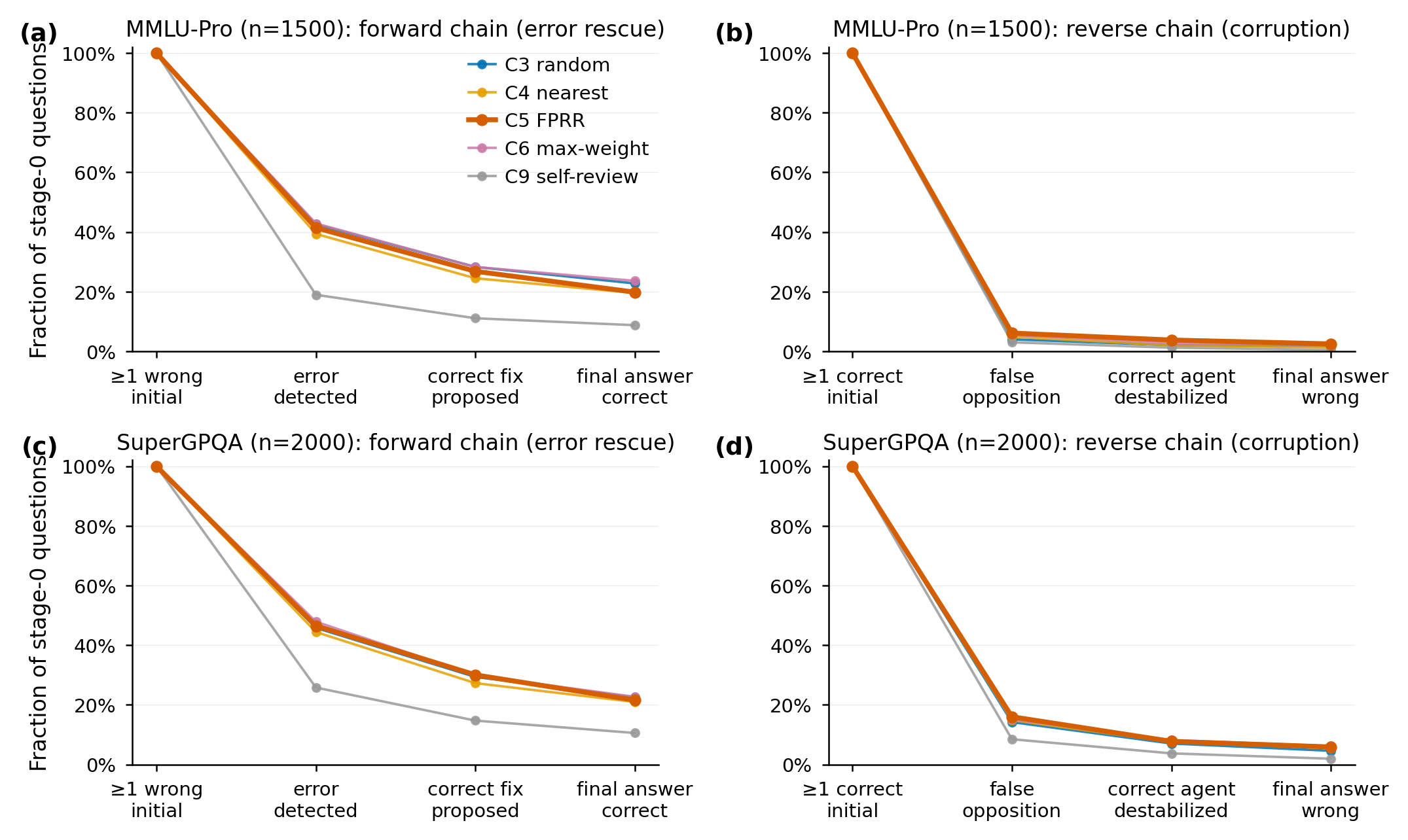
Farthest pairing does make agents spot a peer's errors more often — detection rises monotonically with semantic distance, an order of magnitude between the bottom and top deciles. But detecting an error is not correcting it. Whether a correct fix is proposed, and whether it is adopted, shows no distance effect. The system got better at finding faults, not at fixing them.
Review is active, but net-zero
Every corrected error is matched by another, originally correct answer talked out of position by false opposition — the two directions cancel almost exactly. On the harder benchmark, skipping review entirely and handing the candidates straight to the synthesizer is significantly better (+1.5pp, p=0.010). Review is not a free neutral step; in the wrong place it is a net cost.
The bottleneck is credit assignment
Reviewers occasionally produce correct answers absent from all four initial candidates — genuinely new information — yet under 1.5% of it survives to the final answer. The system cannot tell corrective disagreement from false opposition. Turning disagreement into a small verifiable question is what the next generation of systems should solve.
If you build these systems
Majority voting plus direct synthesis matches every review topology at one fifth of the token cost. Spend the savings on calibration and verification, not on routing cleverness.
Full text & materials
- 中文全文
- English full text
- 日本語全文
- Texte intégral français
- Open-source code and complete experiment records (GitHub)
Cite
@misc{fprr2026,
  title  = {Who Should Review Whom? Response-Conditioned Disassortative Peer Review for Test-Time LLM Reasoning},
  author = {Li, Rui and Sun, Chenglong and Zheng, Xueyan and Liu, Dan},
  year   = {2026},
  month  = sep,
  note   = {Gi (Beijing) Tech Design Ltd.}
}
What's next
The next experiment no longer asks who should talk to whom, but how to tell who is credible inside a disagreement: candidates and budget fixed, we vary only whether the verifier can see the candidate answers, testing whether blindness blocks false opposition. The design is frozen; results will be published the same way.