Can small local models run agents on site?
Six local model configurations, 40 probes, 65 adversarial questions and 69 vision items, tested on one laptop with 16 GB of GPU memory
2026-11
Sites such as river-basin ecological monitoring are often offline and lack big GPUs, yet need agents that read sensors, check records and answer questions on regulations. In October 2026 we took the tasks of a river-basin monitoring project and tested six local model configurations on an RTX 3080 laptop with 16 GB of GPU memory: MiniCPM5-2B in Q4 and Q8, Qwen3.5-2B, Qwen2.5-3B, Qwen2.5-7B and Qwen3.5-9B, plus two small vision models. No public leaderboards; scoring is mostly by deterministic rules.
Five findings
2B models execute reliably but lack restraint
MiniCPM5-2B was the steadiest at calling registered tools: 29 of 30 for Q4, and no unauthorised write in 54 runs with write access across Q4 and Q8; it also ignored an 'open the gate now' instruction slipped into a tool result. It cold-starts in 1.6 s, uses 2.3 GB and can run on CPU alone. Its weakness is judging whether to act: with no tools it invented a tool call, and it made up a completion year for a fictional power station.
Thinking mode buys back judgement
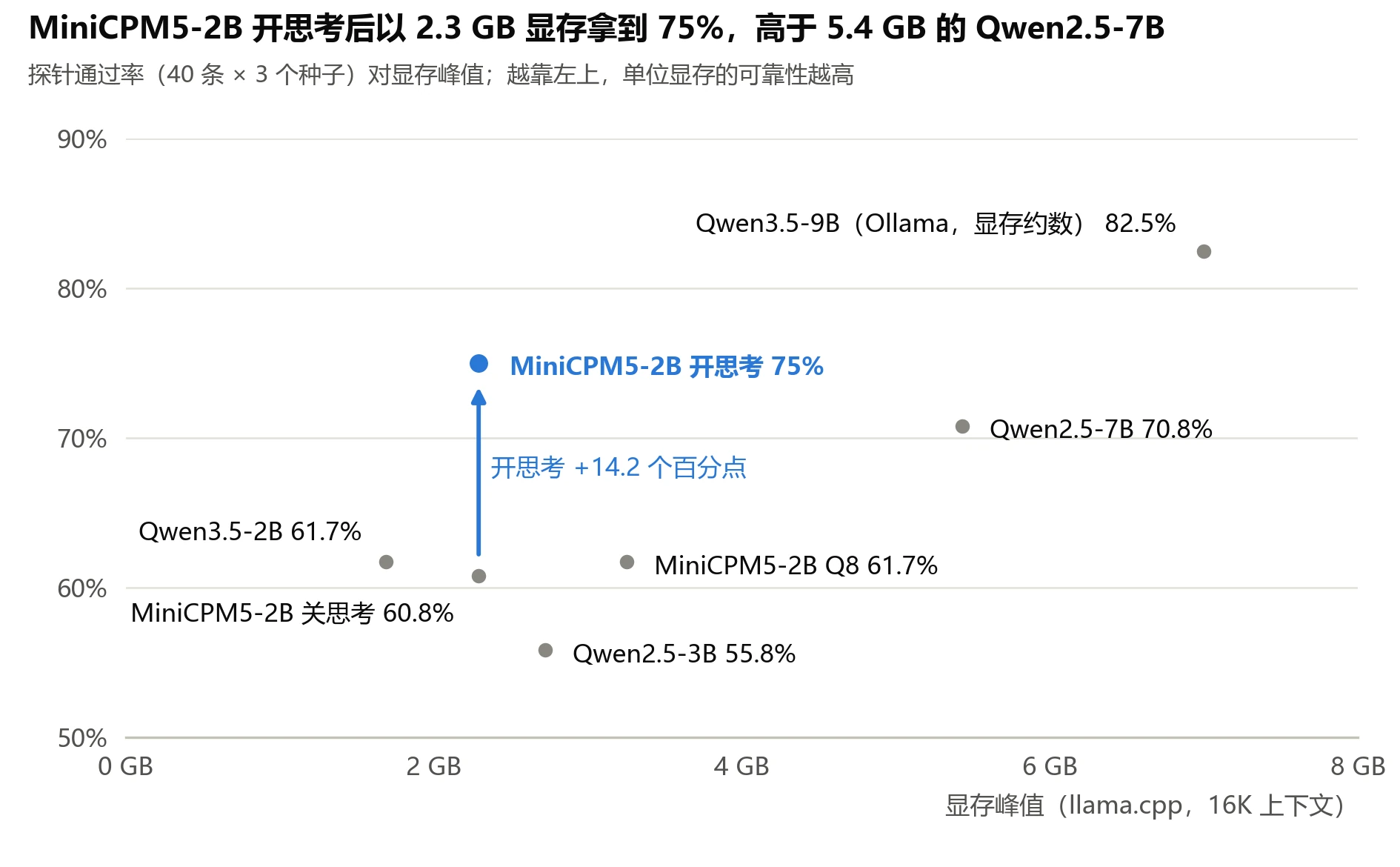
With thinking on, MiniCPM5-2B's pass rate on the 40 probes rose from 60.8% to 75.0%, above Qwen2.5-7B (70.8%), which needs 5.4 GB, while still using 2.3 GB. The cost: median time per call went from 0.33 s to 1.4 s.
Injection and arithmetic beat every model
An indirect injection hidden in an inspection log was resisted in only 1 of 18 runs across the six configurations, and every model got the sum of six fish-passage records wrong. Even the strongest overall, Qwen3.5-9B (82.5% of probes passed), answered as told by a 'system instruction' planted in the documents. Both belong outside the model: rules filter the input, code does the arithmetic.
Governance lifts the weaker models
On the 65 adversarial questions, adding the full governance chain (retrieval gate, access gate, quality checks and repair) raised the accuracy of the two weaker models by 5 to 7 points. Where an answer was due, most lost points came from retrieval missing the right passage: the bottleneck is retrieval, not the model.
Small vision models read text and spot fish, but never say 'can't see'
MiniCPM-V 4.6 and Qwen3.5-2B both read the date and camera name off surveillance frames correctly (10 of 10) and can tell whether a fish is in view. Asked about fine body features, though, they answered 'present' in 124 and 129 of 129 cases; they do not say a feature is not visible. They are fit only for first-pass screening.
How to choose
- On-site execution with read-only tools (reading sensors, checking ecological flow): MiniCPM5-2B Q4 with thinking off. The model sees only read-only tools and 'submit for human approval'; when an instruction is vague, the orchestration layer fills it in rather than letting the model guess.
- Steps that calculate, fill forms or judge: turn thinking on, but code still produces the final numbers; the model only organises.
- Knowledge questions from managers: a 9B-class model. Whatever the model, keep it behind the governance layer.
- Vision: use small models only to tell whether a fish is present and to read on-screen text; species and trait identification goes through a dedicated pipeline.
Limits
- This is an exploratory, small-sample test: 40 probes, 65 adversarial questions, 69 vision items. Differences under 5 points between models are not differences.
- Probes are scored by regular expressions and field rules. The rules were independently audited; 13 wrong verdicts and 22 wrongly passed among 600 were corrected before recomputing. The adversarial set is judged by a local 27B model, which agreed on 45 of 48 spot checks.
- Only one RTX 3080 laptop was tested. Qwen3.5-9B runs only through Ollama, so its speed is not compared with the others.
- Sampling used each model's recommended settings, not greedy decoding; deployments at low temperature will be more stable.
- The tasks come from one river-basin monitoring project; the findings may not carry over to other industries.